
After April 2nd, What Will the Crypto Market Look Like? | Trader's Insight


April 2, 2025, is destined to be a key milestone in the global financial markets, as President Trump is expected to announce corresponding tariff measures at 3:00 p.m. on Wednesday in the White House Rose Garden (3:00 a.m. Beijing time the next day).
Due to concerns about the tariff threat, the U.S. stock market experienced a sharp decline on March 28, with the tech sector leading the plunge. The market value of the seven tech giants (including Apple, Microsoft, Amazon, etc.) evaporated by about $505 billion, and the Philadelphia Semiconductor Index fell by 2.95%. This was the largest single-day drop since the U.S. stock market crash on March 10, marking a severe adjustment at the end of the first quarter of 2025.
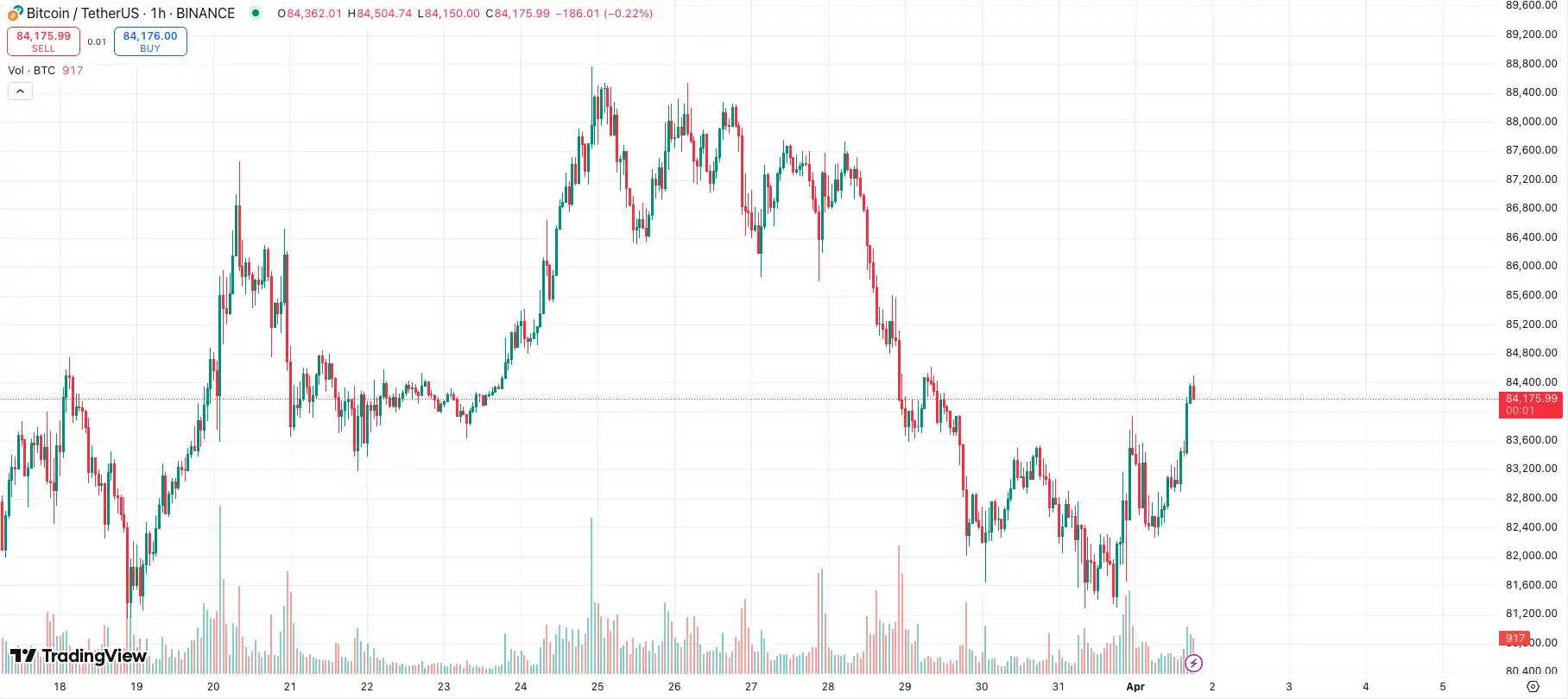
Spilling over to the crypto market, Bitcoin dropped from $84,000 on the afternoon of March 29 to $81,644 in 8 hours, a drop of over 3%. It then rebounded to $83,536 at 6 p.m. on March 30 but failed to hold the gains, falling to $81,565 by 6 a.m. on March 31. The total market capitalization of cryptocurrencies fell from a peak of $3.9 trillion to $2.9 trillion, a 25% decline. Trading volume plummeted from $126 billion after the November 5 election to $35 billion, shrinking by about 70%.
Whether in public or private conversations, Trump has claimed that tariffs are a "win-win" policy that can bring manufacturing jobs back to the U.S. and generate trillions of dollars in new revenue for the federal government. He also stated that allowing advisors to dissuade him from implementing higher tariffs during his first term was a mistake; now he believes that imposing a simple uniform tariff rate on most imported goods will help prevent exemptions from undermining the tariff's effectiveness.
Trump has openly praised the benefits of import taxes, even calling "tariff" the "most beautiful word" in the dictionary and stating that the tariff policy of the 19th century brought about the economic peak in American history. Some allies have even envisioned declaring April 2 as a federal holiday in commemoration of the anniversary of the imposition of tariffs. Trump's former chief strategist in the first term, Steve Bannon, even suggested, "Rather than celebrating Trump's birthday, it is better to establish a 'Liberation Day' as a national holiday to pay tribute to the jobs, skills, and trade that have returned to the U.S. and its workers."
The most likely option to be adopted is the proposal publicly put forward this month by Treasury Secretary Scott Bennett: imposing tariffs on 15% of countries identified by the White House as the worst trading partners, which represent nearly 90% of U.S. imports. In addition, Trump has also advanced other tariff policies that cover all countries but target specific industries. He imposed a 25% tariff on all car imports on Wednesday and hinted at similar measures for industries such as pharmaceuticals and timber.
However, the market's biggest concern is still the sustained uncertainty caused by policy flip-flops, a "blunt knife cutting flesh" type of risk that is forcing traders to reevaluate their second-quarter investment thesis. BlockBeast has compiled analysts' insights from a macroscopic game theory, technical patterns, policy variables, and other dimensions of analysis, combining long and short chip conversion signals and historical structural replication paths to reveal potential trading opportunities and pitfalls in the eye of the storm.
Macro Analysis
1. Whether VAT is included (bearish if yes, bullish if no)
If the reciprocal tariff as previously mentioned considers VAT, then the equivalent tax rate will be higher than expected.
2. Whether Mexico has a tariff exemption (bullish if yes, bearish if no)
As previously stated, in the Lutnick tariff system, Mexico's tariffs are an extension of domestic policy, hoping for their cooperation to promote North American inner cycling for negotiation facilitation. Mexico is the U.S.'s 2nd largest trading partner, and if an exemption can be achieved, inflation pressure will be slightly reduced.
3. How the U.S. Dollar Index responds
The tariffs trigger supply-side-driven inflation, and supply inflation and the strength of the dollar will react to each other—the rebound of DXY at the bottom will hedge part of the tariff effect; if DXY continues to decline, future inflationary pressure will increase.
The strength of the dollar is an amplifier of supply-side inflation, and if the dollar appreciates, inflation pressure will relatively weaken.
4. Expected Changes
The macro environment in Q1 was not bad, with ample liquidity, QT slowing, and 10-year yield and DXY falling. However, starting from February, with changes in policy expectations, the crypto market has seen multiple "Black Mondays" during U.S. stock futures trading hours, from deepseek valuation compression, to weekend sudden Mexico tariff retaliation, to recession-expectation trading. In summary, there are only three expected changes:
①"Reinflation expectation" brought by tariffs
②"Recession expectation" caused by softening economic data and Fed's wait-and-see approach leading to stagflation
③"Adjustment expectation" that valuations post-pandemic are too high
Personally, in trading, if these three expectations cannot be reversed, it will be difficult to reverse the 78,000-91,000 range previously priced in the chart. So far, I haven't seen any concessions on tariffs, so if they exceed expectations, look for divergences to take reverse actions.
A bullish opportunity for 2025 may arise from the impact of tariffs settling + the expectation reversal brought by tax reduction bills (there are no signs of tax reduction bills yet, so wait patiently).
Actually, up to now, Bitcoin's safe-haven sentiment has improved a lot. The morning after the opening of U.S. stock index futures, all indices have dropped sharply, mainly because it is almost the 2nd [of the month], facing the uncertainty of tariffs, many investors have chosen to hedge. Currently, the Nasdaq futures are down more than 1.2%, S&P 500 futures are down 0.75%, and Asian market investors have taken the lead to exit.
Now the market is waiting for Trump's final tariff implementation, and what the market is most worried about is not a one-time tariff, but Trump's repeated adjustments to the tariff, which may make the market feel more at risk.
But it is important to note that rising difficulty does not necessarily mean a decline, because it is still event-driven. Perhaps at some point, Trump will reverse again, that’s what makes it difficult. The second quarter may be more challenging compared to the first quarter, with inflation, tariffs, the Fed maintaining rates, and Japan raising rates all potentially affecting the risk market. The April tariff will be a key reason for the increasing difficulty in the risk market, and the assessment of tariffs cannot be easily summarized in a single sentence. It's more about "game theory."
This is the ASR-VC daily channel during the last round of oscillation before the bull market turned bearish, which indeed has some similarities to the current situation;
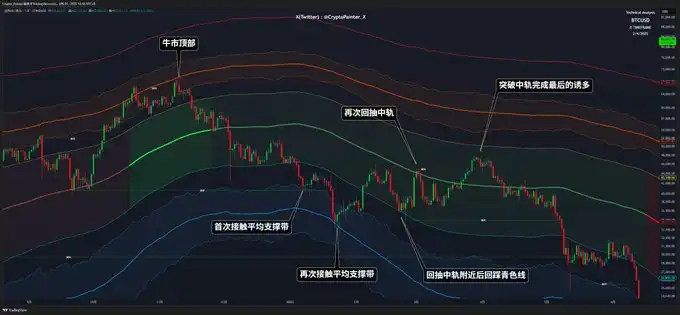
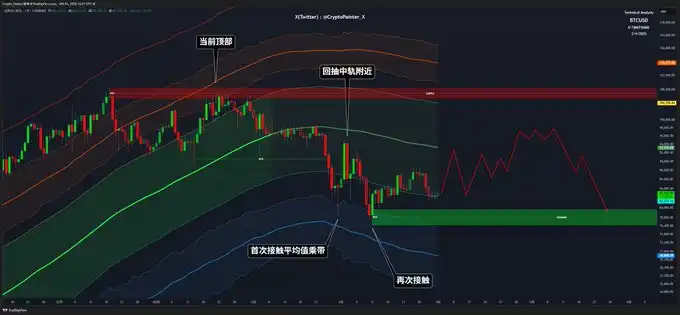
I have drawn on the chart a potential path that replicates a similar structure. The general idea is that if this is the final stage of the bull to bear transition, then we still need to wait for one last bull trap.
Still, I do not recommend simple pattern matching. The inductive method does not work well in the market, but understanding the previous structural trends and their reasons, and applying the same logical deduction to the present, is still feasible.
Personal opinion: each party essentially subdivides the tariffs into multiple scenarios, with the core being the previously discussed mild version and the most hardline version. Other scenarios oscillate between these two versions. What needs to be considered for market performance is:
1) If it’s the most hardline version, will the days after the 2nd be the peak of uncertainty for a period in the future? Because the most hardline version will definitely trigger the most pessimistic market expectations and cause a huge impact. After that, each country will negotiate with the U.S. separately, because the worst-case scenario has already appeared. Subsequent negotiations, once there is any progress, will boost market confidence.
2) If it's the mild version, the market should be fine that day, and confidence will naturally improve. However, the subsequent game will definitely be back and forth. So after the market surges on the 2nd and 3rd, it will move in a start-and-stop manner, taking two steps forward and one or two steps back, and the back-and-forth grind will also take a long time.
Technical Analysis
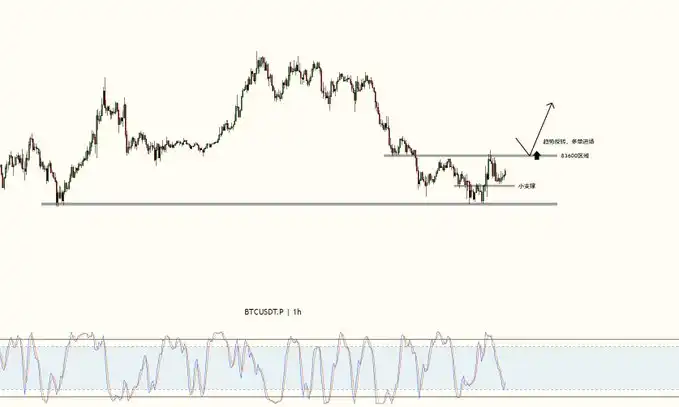
Currently, the 1H chart is still in a downtrend box, but there is a short-term reversal pattern within the box, accompanied by a bullish crossover on indicators. First, it will retest the 83600 area, observing the potential resistance.
The next opportunity to enter a long position is already marked on the chart and involves executing a "breakout-retest rebound" strategy.
In the short term, BTC continues its downtrend. A false breakout above the 83000 resistance level appeared on the 4H chart, and now the price has dropped back down. In the short term, it is expected to drop to 79.5 to form the first low, then rebound after the tariff announcement on Wednesday, creating a bullish sentiment, followed by a double bottom around 78k. Refer to the chart below for the trend.
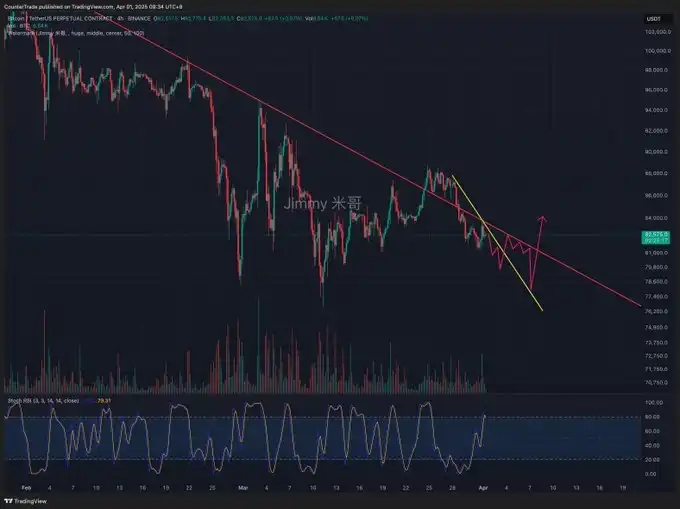
1. Channels are a very weak structure, as they exist to be broken, based on my experience;
2. If we consider the drop from 109000 to 76000 as the first stage of the entire decline, the rebound from 76000 to the present has not completed, as shown in the chart:
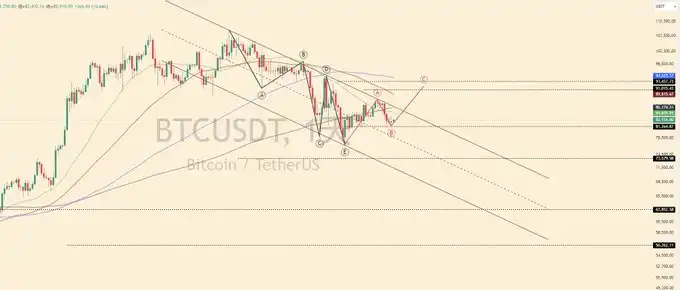
3. Continuous selling pressure requires a technical indicator reset.
Subjective Speculation:
1. The current hype is driven by expectations of inflation due to tariffs and the impending recession, rather than an actual recession about to occur. As I mentioned in my previous post, we need to observe price action leading up to April 2nd when the boot drops. When emotions and prices reach a critical point, look for opportunities to take a contrarian position;
2. Fact 1: The fact that we are currently undergoing a long/short transformation, with daily moving averages turning downwards, MA30, MA60, MA120 forming a bearish alignment. From both a technical and macro perspective, there is no possibility of a bullish reversal. Fact 2: If this adjustment is aimed at correcting the significant uptrend from 15476 to 109000, then the scale of this correction will be significant. Significant corrections always involve back-and-forth movements rather than a straight downward trajectory. Therefore, no reversal does not mean no rebound.
3. Unloading Assumption Round: In a situation where the downside capital is insufficient and a small amount of capital can control the market trend, the cost for institutional funds to control the market is reduced. The back-and-forth manipulation helps raise the average price at which institutional funds unload. Shitcoins can lie flat and die, showing weak-handed unloading behavior. However, high-quality assets like the large-cap cryptocurrency have the confidence to unload at a high position.
The upcoming trend may unfold in two possible ways.
The first possibility is to retest below 81200 to achieve complete resonance in indicators, confirming a major bottom. The second is to start rebounding from here, with 81200 as the bottom (although not a strong resonance, the phenomenon of bottoming out with two resonances exists).
Considering the news backdrop, I believe that after the tariff conclusion on April 2nd, we can roughly determine the direction (final drop vs. bottoming rebound). Given that this is the first time the Acc indicator has turned green since March 11, it is definitely not advisable to be completely out of the market at this point.
You may also like

Japan’s Three Megabanks Plan Joint Stablecoin Issuance in Fiscal 2026
MUFG, SMBC, and Mizuho reportedly plan to jointly issue fiat-pegged stablecoins in fiscal 2026, signaling Japan’s growing push into bank-led digital payment infrastructure.

Humanity Discloses H Token Dual-Chain Attack Details, With Losses on Ethereum and BSC Exceeding $36 Million
Humanity said the H token attack across Ethereum and BSC caused more than $36 million in losses after leaked ProxyAdmin keys enabled malicious contract upgrades and token minting.

White House Discusses CLARITY Act With Law Enforcement Ahead of Senate Vote
The White House discussed the CLARITY Act with law enforcement ahead of a Senate vote, focusing on illicit finance risks and developer protections.

$75 billion in foreign capital has fled, and South Korean retail investors have absorbed it all using leverage

Bitcoin Trading Guide 2026: Strategies for Experienced Traders

What Is XAUT and PAXG? Why Tokenized Gold Is Booming in 2026

Cryptocurrency CEXs are flocking to sell US stocks, and traditional brokerages are facing an "uninvited guest."

Will the SpaceX IPO Hurt Bitcoin? Here's What Traders Are Watching
Foreign selling in the South Korean stock market accelerates, with cumulative net sales reportedly reaching $75 billion this year
On June 9, The Kobeissi Letter, citing Goldman Sachs data, reported that global investors are selling South Korean stocks at an unusually rapid pace. In the latest trading session, foreign investors sold about $801 million worth of Kospi constituent stocks again; total foreign outflows last week reached about $10 billion, and the market has been in net foreign selling on nearly every trading day over the past month. According to the data cited in the report, foreign investors have sold about $75 billion worth of South Korean stocks so far this year. Meanwhile, South Korean retail and institutional investors together recorded roughly $69 billion in net buying over the same period, suggesting that the market’s main buying support has come from domestic capital rather than returning overseas funds. The information currently disclosed still mainly comes from The Kobeissi Letter’s retelling and Goldman Sachs data summaries, while public details on the statistical period and the specific definition of “selling” remain relatively limited.

Fortune Warns of Strategy’s Financing Structure Risks as Bitcoin Premium Narrows
Fortune warned that Strategy’s Bitcoin treasury model faces growing financing risks as MSTR’s net asset premium narrows and preferred stock dividend pressure increases.

Ferrari Challenge Le Mans: Carl Moon to Dominate in WEEX Livery

Sahara AI Responds to SAHARA’s Sharp Drop: No Contract or Product Security Issues Found, Internal Investigation Underway
Sahara AI responded to SAHARA’s 60% price drop, saying no token contract or product security issues have been found and an internal investigation is underway.

WEEX Deposit/Withdrawal Dynamic Island: Your Asset Status, Always in Sight
Scaling Crypto Derivatives: The Digital Asset Infrastructure Behind High-Volume Trading
In the fast-moving digital asset ecosystem, derivatives platforms face an extreme architectural test. High-leverage futures markets demand more than just standard security—they require absolute operational precision, zero-latency matching engines, and ironclad structural scalability, all while navigating intense market volatility.
As global platforms scale to meet these demands, the industry is shifting away from rigid, monolithic setups toward a more agile, "decoupled" infrastructure philosophy.
The Blueprint for High-Volume Copy TradingFor elite global exchanges like WEEX (founded in 2018), this architectural choice becomes critical when scaling high-volume retail features like social copy trading. When thousands of users automatically mirror the real-time strategies of elite traders simultaneously, it triggers sudden, monumental spikes in concurrent transactional volume.
To prevent execution latency or settlement bottlenecks during these peak volatility events, a platform's primary engine must remain entirely dedicated to risk management, copy-trade synchronization, and order matching.
The Architectural Rule: New-generation platforms must separate front-end user execution engines from heavy backend infrastructural overhead to eliminate operational friction.
By separating these layers, platforms can maintain complete sovereignty over their trading environments and user experiences while strategically aligning with institutional-grade infrastructure ecosystems. This strategic framework allows modern exchanges to leverage advanced Digital Asset Custody infrastructure such as Cobo’s behind the scenes, ensuring that backend wallet management scales elastically alongside trading spikes.
Capitalizing on Market Momentum and 400× LeverageIn a derivatives arena where platforms offer up to 400× leverage on perpetual contracts, capital efficiency and market agility are core business metrics. To capture market momentum, an exchange needs the ability to rapidly expand its asset offerings, supporting everything from legacy crypto assets to sudden, trending altcoins across a massive library of trading pairs.
Adopting a flexible, scalable Wallet-as-a-Service (WaaS) solution such as Cobo’s could completely rewrite the development timeline for high-growth exchanges. Instead of spending months of engineering capital building out custom backend wallet architectures for every new blockchain network, platforms can deploy localized infrastructure in days.
This agility allows platforms to instantly scale their listings to over a thousand trading pairs without compromising security or delaying time-to-market. It mirrors the exact operational advantages seen during high-velocity market events, similar to how advanced wallet infrastructure empowers platforms during sudden asset surges; allowing exchanges to pass that speed and liquidity directly to their global user base.
A Mature Foundation for GrowthThe synergy between trusted infrastructure ecosystems and global trading platforms represents the natural evolution of a maturing crypto market. As WEEX continues to scale its global spot and derivatives offerings for over 6 million users, adopting robust backend paradigms proves that platforms no longer have to compromise between cutting-edge trading velocity and uncompromised structural security.

Morning Report | BitMine increased its holdings by 126,971 ETH last week; trader Eugene announced his exit from the crypto market

Wang Chuan: How can one not feel anxious after the neighbor Old Wang made thirty times profit by investing in storage stocks? (Seven) - A quarter-century cycle

Get Paid to Onboard? Try WEEX’s New Homepage with Rewards for Registration, Deposit & Trade
WEEX Custom Layout: Build Your Perfect Trading Workspace in Seconds
Japan’s Three Megabanks Plan Joint Stablecoin Issuance in Fiscal 2026
MUFG, SMBC, and Mizuho reportedly plan to jointly issue fiat-pegged stablecoins in fiscal 2026, signaling Japan’s growing push into bank-led digital payment infrastructure.
Humanity Discloses H Token Dual-Chain Attack Details, With Losses on Ethereum and BSC Exceeding $36 Million
Humanity said the H token attack across Ethereum and BSC caused more than $36 million in losses after leaked ProxyAdmin keys enabled malicious contract upgrades and token minting.
White House Discusses CLARITY Act With Law Enforcement Ahead of Senate Vote
The White House discussed the CLARITY Act with law enforcement ahead of a Senate vote, focusing on illicit finance risks and developer protections.
$75 billion in foreign capital has fled, and South Korean retail investors have absorbed it all using leverage
Bitcoin Trading Guide 2026: Strategies for Experienced Traders
What Is XAUT and PAXG? Why Tokenized Gold Is Booming in 2026


