
Binance Insider Trading: Why Does Front-Running Persist Even After Employee Caught Red-Handed?


Original Article Title: "Binance Employee Caught Insider Trading: Why Does Insider Trading Persist?"
Original Article Author: ChandlerZ, Foresight News
On March 24, according to an official announcement by Binance, its internal audit team received a report on March 23, 2025, accusing an employee of conducting front-running trades using insider information to gain undue profits. Binance has initiated a comprehensive internal investigation.
At the time of the alleged incident, the individual was working within Binance's Wallet team, which had no business relationship or cooperation with the project in question. However, it is alleged that the individual abused prior position information for personal gain. Before joining the Wallet team a month ago, the employee held a business development role at BNB Chain. By leveraging information obtained during their previous role and familiarity with the on-chain project, the employee knew about the project's Token Generation Event (TGE) and purchased a significant amount of project tokens through multiple linked wallet addresses before the project publicly announced the token.
Following the announcement, the employee quickly sold a portion of the held tokens, realizing substantial profits, while retaining a considerable unrealized gain in the remaining tokens. Based on non-public information obtained from their previous position, this conduct constitutes front-running, a clear violation of company policy.
The preliminary investigation has concluded, and the individual involved has been suspended pending legal action. Additionally, Binance has completed report verification and deduplication work and distributed a $100,000 reward evenly among reporters.
Blockchain Evidence Captures the "Rat's Tail"
According to user X, exposed by BroLeon, Binance employee Freddie Ng has been accused of involvement in illegal insider trading, participating in a UUU token manipulation arbitrage worth $110,000. After publicly sharing on-chain evidence, he demanded that Binance provide a reasonable explanation for the matter.
BroLeon stated, "UUU token insider trading has been confirmed! I have just verified this report, and the entire theft process has been exposed on-chain. I wonder how this time the Binance Wallet BD and Growth employee Freddie Ng, caught in this insider trading, will be dealt with."
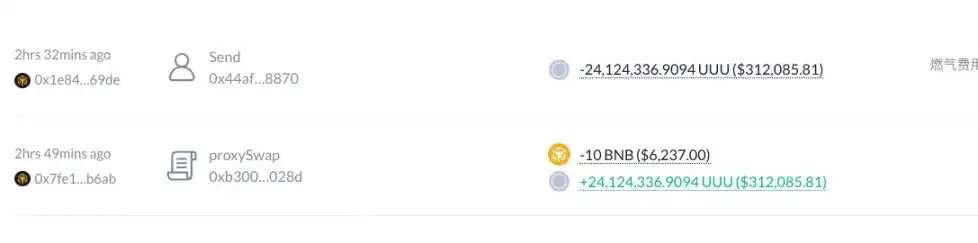
Based on the detailed crime process, a Binance employee named Freddie Ng was undoubtedly aware in advance that the UUU token was going to pump. Using their pseudonymous wallet address starting with 0xEDb0, they spent 10 BNB at an average price of $0.00026 to buy 24.1 million tokens worth $31,200 and transferred them all to a wallet starting with 0x44a.
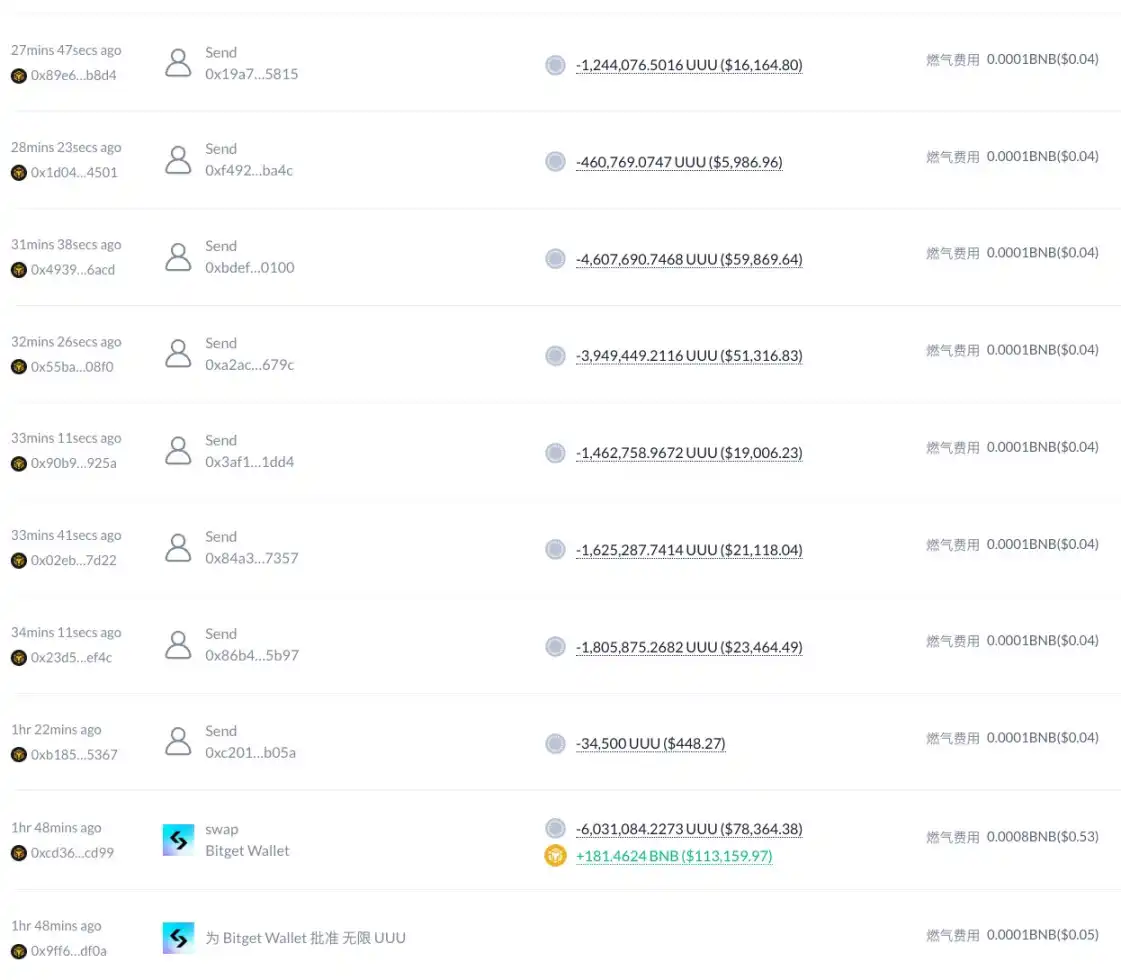
Subsequently, Freddie sold 6.02 million UUU at an average price of $0.0188 through the Bitget wallet, receiving $113,600, and distributed the remaining UUU tokens to 8 different addresses, each receiving tens of thousands of dollars.
BroLeon said, "The slip-up this guy made was that the wallet he used for the rug pull was funded 121 days ago from his identified wallet freddieng.bnb (starting with 0x77C)."
On March 23, the BNB Chain exchange platform uDex officially listed the official token UUU on four.meme. uDex is one of the members of the BNBChain MVB Season 8, providing on-chain information to users and allowing direct trading from social networks. Currently, the token has a market capitalization of $8.22 million.
Industry Chronic Issues
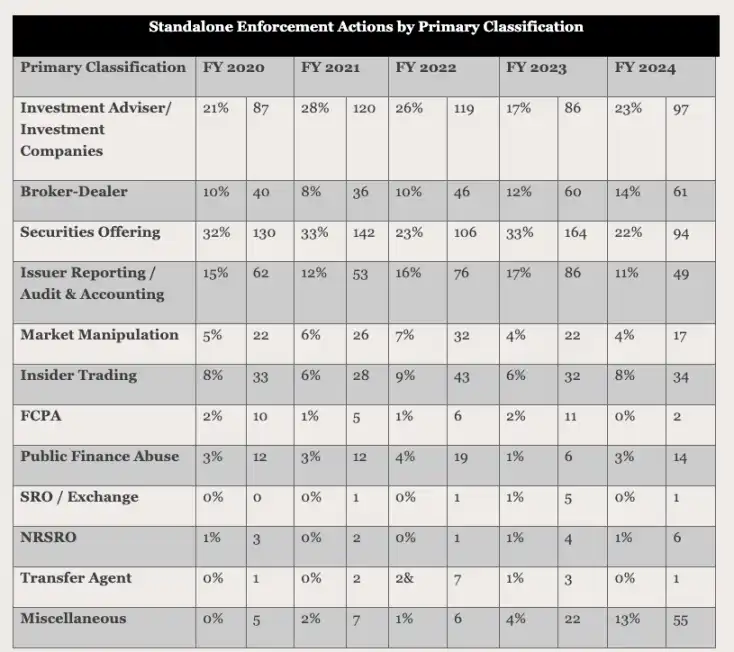
Insider trading is not a unique issue to the cryptocurrency market. For example, based on historical data from the U.S. Securities and Exchange Commission (SEC), insider trading enforcement cases on average represent 8-9% of the annual enforcement total, a proportion that already exists in traditional financial markets.
This is not the first time Binance has faced allegations of insider trading, although there have been few instances of employees being investigated in the past. Since 2018, the cryptocurrency industry has consistently faced systematic questions regarding insider trading within exchanges. Several exchanges have been accused at different times of similar rug pull issues, becoming chronic issues in the industry.
The transparency and decentralization features of the cryptocurrency market have not completely eliminated the risk of insider trading. Instead, due to a lack of unified regulation and imperfect internal controls, exchanges are prone to such activities. Despite major exchanges enhancing compliance and risk control systems, the anonymity of cryptocurrencies, technological complexity, and global operational models make traditional regulatory measures challenging to enforce.
Industry giants like Binance often exert strong deterrence measures when facing internal trading abuse issues but also frequently experience similar incidents due to a lack of effective preventive and monitoring measures. Externally, Binance's swift investigation results and actions in this case demonstrate its determination to rectify the situation. However, whether they can completely eliminate rug pull issues requires the industry to strengthen compliance management and transparency from the source.
You may also like

Cryptocurrency CEXs are flocking to sell US stocks, and traditional brokerages are facing an "uninvited guest."

Will the SpaceX IPO Hurt Bitcoin? Here's What Traders Are Watching
Foreign selling in the South Korean stock market accelerates, with cumulative net sales reportedly reaching $75 billion this year
On June 9, The Kobeissi Letter, citing Goldman Sachs data, reported that global investors are selling South Korean stocks at an unusually rapid pace. In the latest trading session, foreign investors sold about $801 million worth of Kospi constituent stocks again; total foreign outflows last week reached about $10 billion, and the market has been in net foreign selling on nearly every trading day over the past month. According to the data cited in the report, foreign investors have sold about $75 billion worth of South Korean stocks so far this year. Meanwhile, South Korean retail and institutional investors together recorded roughly $69 billion in net buying over the same period, suggesting that the market’s main buying support has come from domestic capital rather than returning overseas funds. The information currently disclosed still mainly comes from The Kobeissi Letter’s retelling and Goldman Sachs data summaries, while public details on the statistical period and the specific definition of “selling” remain relatively limited.

Fortune Warns of Strategy’s Financing Structure Risks as Bitcoin Premium Narrows
Fortune warned that Strategy’s Bitcoin treasury model faces growing financing risks as MSTR’s net asset premium narrows and preferred stock dividend pressure increases.

Ferrari Challenge Le Mans: Carl Moon to Dominate in WEEX Livery

Sahara AI Responds to SAHARA’s Sharp Drop: No Contract or Product Security Issues Found, Internal Investigation Underway
Sahara AI responded to SAHARA’s 60% price drop, saying no token contract or product security issues have been found and an internal investigation is underway.

WEEX Deposit/Withdrawal Dynamic Island: Your Asset Status, Always in Sight

Scaling Crypto Derivatives: The Digital Asset Infrastructure Behind High-Volume Trading
In the fast-moving digital asset ecosystem, derivatives platforms face an extreme architectural test. High-leverage futures markets demand more than just standard security—they require absolute operational precision, zero-latency matching engines, and ironclad structural scalability, all while navigating intense market volatility.
As global platforms scale to meet these demands, the industry is shifting away from rigid, monolithic setups toward a more agile, "decoupled" infrastructure philosophy.
The Blueprint for High-Volume Copy TradingFor elite global exchanges like WEEX (founded in 2018), this architectural choice becomes critical when scaling high-volume retail features like social copy trading. When thousands of users automatically mirror the real-time strategies of elite traders simultaneously, it triggers sudden, monumental spikes in concurrent transactional volume.
To prevent execution latency or settlement bottlenecks during these peak volatility events, a platform's primary engine must remain entirely dedicated to risk management, copy-trade synchronization, and order matching.
The Architectural Rule: New-generation platforms must separate front-end user execution engines from heavy backend infrastructural overhead to eliminate operational friction.
By separating these layers, platforms can maintain complete sovereignty over their trading environments and user experiences while strategically aligning with institutional-grade infrastructure ecosystems. This strategic framework allows modern exchanges to leverage advanced Digital Asset Custody infrastructure such as Cobo’s behind the scenes, ensuring that backend wallet management scales elastically alongside trading spikes.
Capitalizing on Market Momentum and 400× LeverageIn a derivatives arena where platforms offer up to 400× leverage on perpetual contracts, capital efficiency and market agility are core business metrics. To capture market momentum, an exchange needs the ability to rapidly expand its asset offerings, supporting everything from legacy crypto assets to sudden, trending altcoins across a massive library of trading pairs.
Adopting a flexible, scalable Wallet-as-a-Service (WaaS) solution such as Cobo’s could completely rewrite the development timeline for high-growth exchanges. Instead of spending months of engineering capital building out custom backend wallet architectures for every new blockchain network, platforms can deploy localized infrastructure in days.
This agility allows platforms to instantly scale their listings to over a thousand trading pairs without compromising security or delaying time-to-market. It mirrors the exact operational advantages seen during high-velocity market events, similar to how advanced wallet infrastructure empowers platforms during sudden asset surges; allowing exchanges to pass that speed and liquidity directly to their global user base.
A Mature Foundation for GrowthThe synergy between trusted infrastructure ecosystems and global trading platforms represents the natural evolution of a maturing crypto market. As WEEX continues to scale its global spot and derivatives offerings for over 6 million users, adopting robust backend paradigms proves that platforms no longer have to compromise between cutting-edge trading velocity and uncompromised structural security.

Morning Report | BitMine increased its holdings by 126,971 ETH last week; trader Eugene announced his exit from the crypto market

Wang Chuan: How can one not feel anxious after the neighbor Old Wang made thirty times profit by investing in storage stocks? (Seven) - A quarter-century cycle

Get Paid to Onboard? Try WEEX’s New Homepage with Rewards for Registration, Deposit & Trade

WEEX Custom Layout: Build Your Perfect Trading Workspace in Seconds

See “Buy Walls” & “Sell Walls” Instantly: WEEX Launches the Depth Chart for Smarter Trades

What Is Quick Trade on WEEX? 2 Ways WEEX Ends Chart-Panel Jumping
Morning News | Five major virtual asset platforms in South Korea have experienced 57 incidents of hacking and system failures in six years; Grayscale submits registration application for Canton ETF

Should we escape the peak? The principle of the tail-end market in the stock market

RootData: May 2026 Cryptocurrency Exchange Transparency Research Report

Founder of Baixing.com: My Experience with Claude Code in Fourteen Points
Cryptocurrency CEXs are flocking to sell US stocks, and traditional brokerages are facing an "uninvited guest."
Will the SpaceX IPO Hurt Bitcoin? Here's What Traders Are Watching
Foreign selling in the South Korean stock market accelerates, with cumulative net sales reportedly reaching $75 billion this year
On June 9, The Kobeissi Letter, citing Goldman Sachs data, reported that global investors are selling South Korean stocks at an unusually rapid pace. In the latest trading session, foreign investors sold about $801 million worth of Kospi constituent stocks again; total foreign outflows last week reached about $10 billion, and the market has been in net foreign selling on nearly every trading day over the past month. According to the data cited in the report, foreign investors have sold about $75 billion worth of South Korean stocks so far this year. Meanwhile, South Korean retail and institutional investors together recorded roughly $69 billion in net buying over the same period, suggesting that the market’s main buying support has come from domestic capital rather than returning overseas funds. The information currently disclosed still mainly comes from The Kobeissi Letter’s retelling and Goldman Sachs data summaries, while public details on the statistical period and the specific definition of “selling” remain relatively limited.
Fortune Warns of Strategy’s Financing Structure Risks as Bitcoin Premium Narrows
Fortune warned that Strategy’s Bitcoin treasury model faces growing financing risks as MSTR’s net asset premium narrows and preferred stock dividend pressure increases.
Ferrari Challenge Le Mans: Carl Moon to Dominate in WEEX Livery
Sahara AI Responds to SAHARA’s Sharp Drop: No Contract or Product Security Issues Found, Internal Investigation Underway
Sahara AI responded to SAHARA’s 60% price drop, saying no token contract or product security issues have been found and an internal investigation is underway.


