
CoinGecko Spot Report: Overview of 12 Major CEX Spot Markets, Only 32% of New Tokens Outperforming IEO Price


Original Article Title: Spot CEX Report 2026
Original Source: CoinGecko
Original Translation: Deep Tide TechFlow
Deep Tide Summary: CoinGecko has released the 2026 Spot CEX Report, covering the top 12 global centralized exchange platforms. The report revealed several key facts: USDT and USDC account for nearly 98% of stablecoin trading pairs; only 32% of newly listed tokens outperformed their issuance price in the short term, with almost all dipping below the issuance price after 12 months; total reserves on exchanges increased from $1.521 trillion to $2.254 trillion; funds are flowing from institutional platforms like Coinbase to retail-driven platforms like Bitget and MEXC.
Since the birth of the crypto market, centralized exchange platforms (CEXs) have been the core gateway for both retail and institutional players to access liquidity. In just 2025, the spot markets of the top 12 CEXs processed nearly $21 trillion in trading volume. As the industry matures, the focus of the market is shifting towards the sustainability of spot trading activity and the health of the underlying reserves supporting these massive trades.
The competitive landscape of CEXs is evolving. USDT and USDC dominate trading pairs, and the performance of newly listed coins remains a significant challenge. The total reserves of the top 12 CEXs in 2026 reached $2.254 trillion, with funds moving from institutional giants towards high-turnover, retail-driven platforms.
Below are the four key findings of the report. The full report spans 21 pages, and it is recommended to download and read.
1. USDT and USDC Account for 66.6% of Trading Pairs, Stablecoins Almost Monopolize Spot Trading
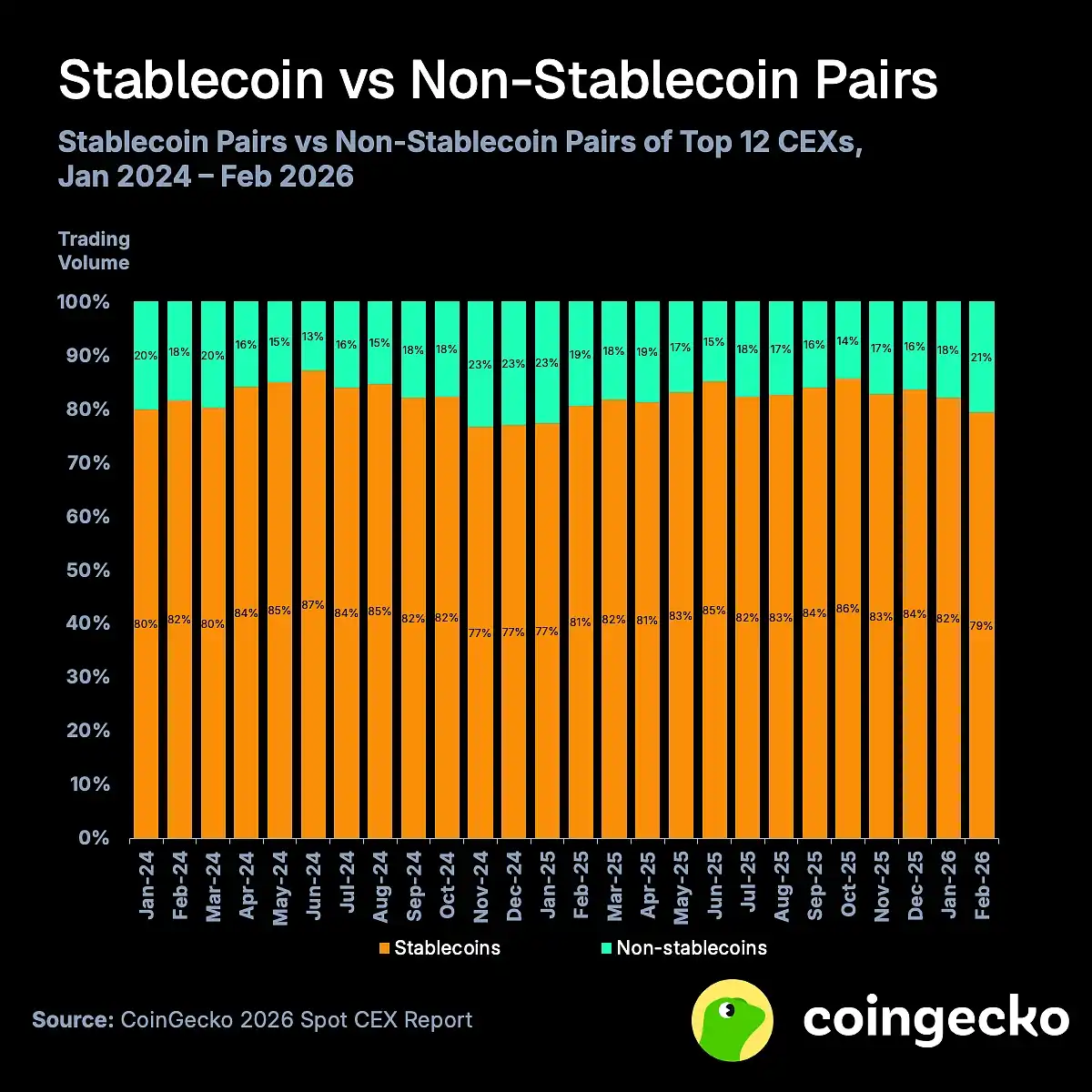
Figure: Proportion of Stablecoin and Non-Stablecoin Trading Pairs on the Top 12 CEXs
The vast majority of spot trading volume on the top 12 CEXs is completed through stablecoin trading pairs like USDT and USDC.
Specifically, out of 9,870 stablecoin trading pairs, 9,646 are USDT or USDC pairs, accounting for 97.7%. There are a total of 4,615 non-stablecoin trading pairs, representing 31.9% of all 14,485 trading pairs.
However, the number of trading pairs does not directly correlate with trading volume. The share of non-stablecoin trading pairs reached its peak in November 2024, at only 23%.
2. Peak of New Coin Listing: Only 32% Saw Short-Term Gains, Nearly Wiped Out After 12 Months
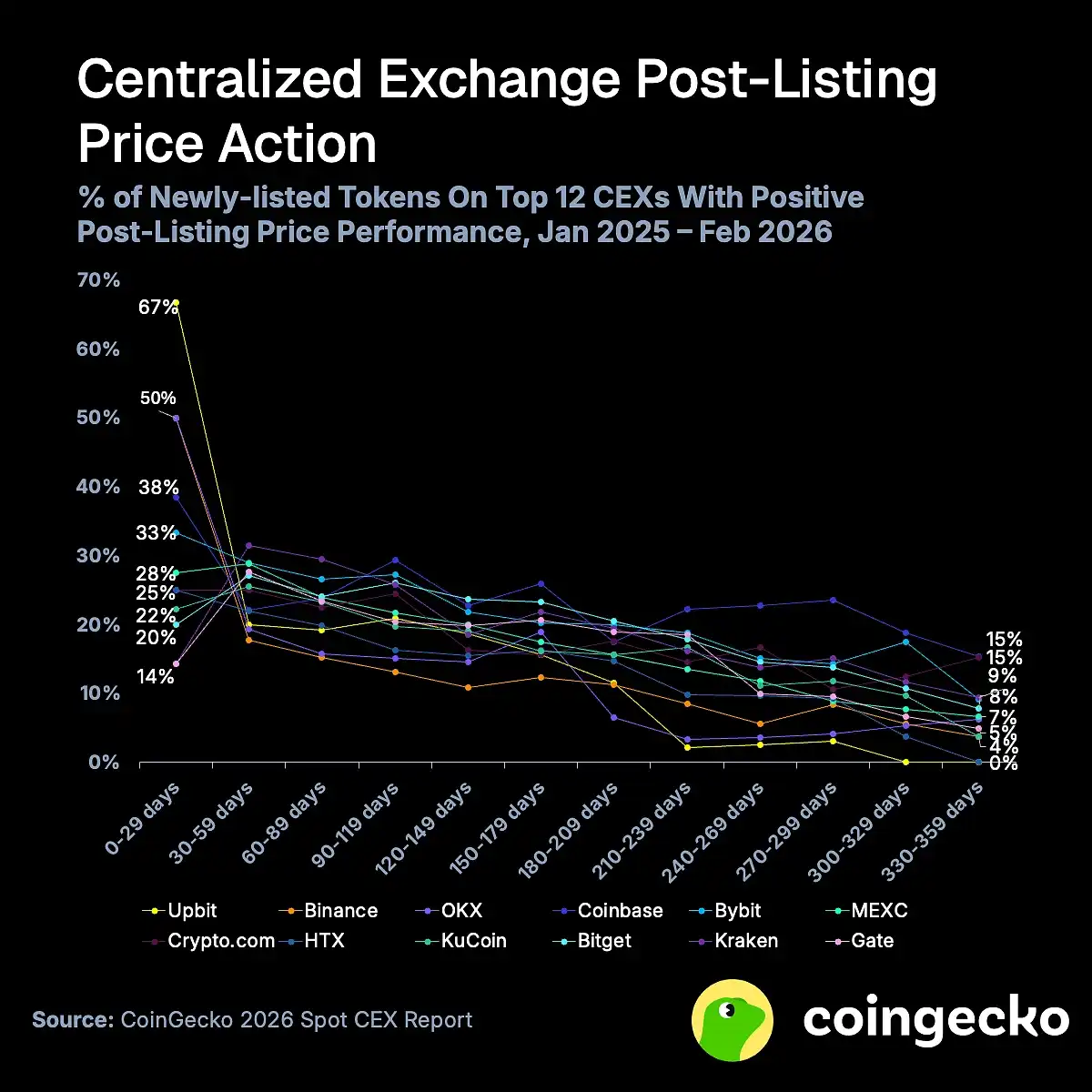
Chart: Price Performance of 12 Major CEX-Listed Tokens
Among the top 12 exchanges, Upbit had the best short-term performance after listing new coins, with 67% of new coins still profitable after 30 days of listing. However, Upbit also had the fewest listings. Following Upbit were Binance and OKX, with a 50% profit rate after 30 days.
There was a significant performance difference among exchanges in the first 0-29 days after listing, but the gap rapidly narrowed after 30 days. On average, only 25% of tokens were still profitable 30-59 days after listing.
Looking at a longer time frame, the performance of exchanges tended to linearly decline. The only exception was Coinbase, where newly listed tokens saw a "recovery" six months after listing.
By the 12-month mark, in most tokens listed on major exchanges, less than 10% were trading above the listing price. Upbit's data was particularly dramatic: starting strong but crashing the fastest, by days 300-329, all newly listed tokens were trading below the listing price.
3. Total Reserves of 12 Major CEXs Increased from $152.1B to $225.4B, Binance Doubled its Lead
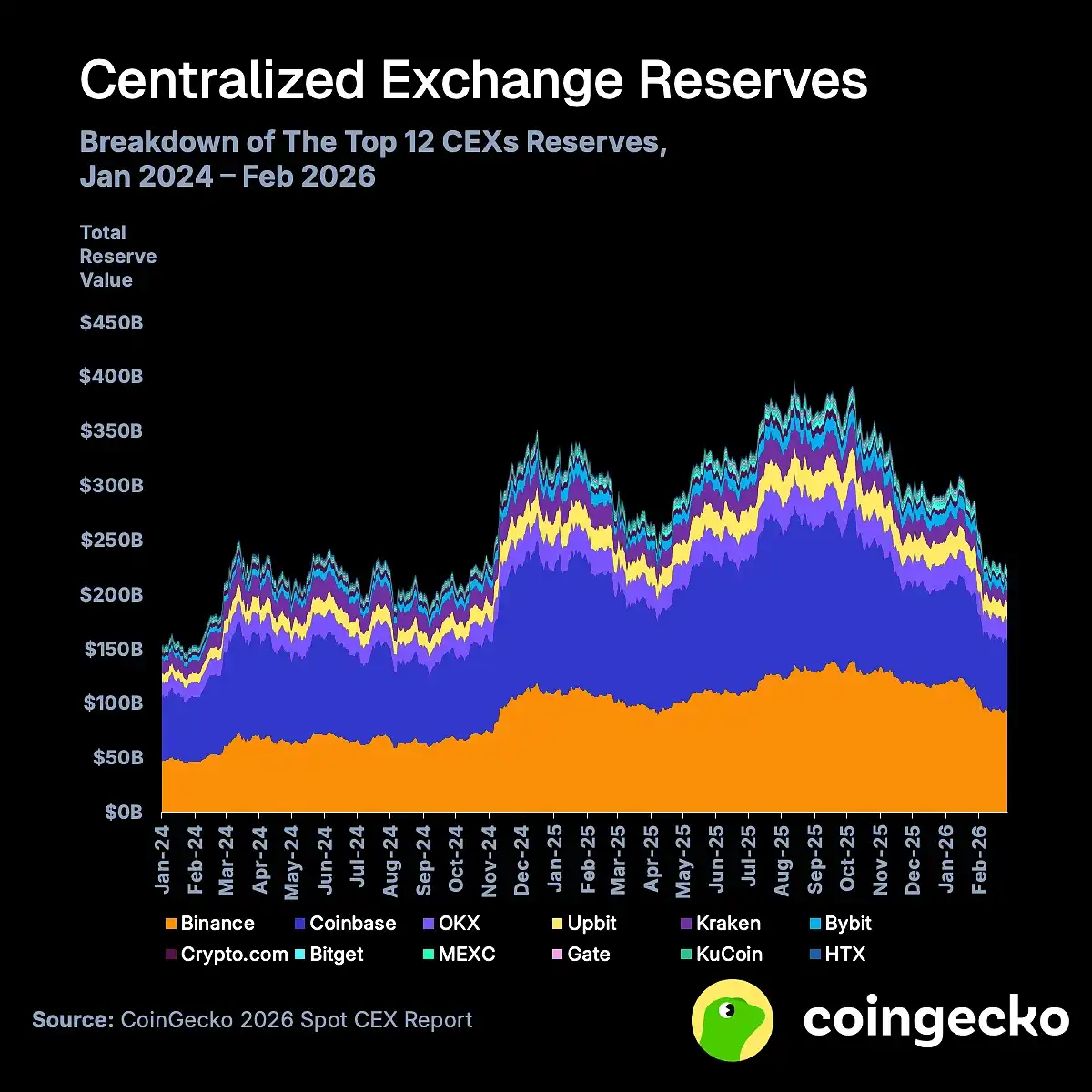
Chart: Changes in Value of 12 Major CEX Reserve Assets (2024-2026)
Despite the price surge of BTC and ETH boosting the reserve value of most exchanges, price volatility and stricter regulations are driving users to move funds from large exchanges to other platforms.
From early 2024 to the end of February 2026, the total value of underlying assets of the top 12 CEXs grew by an average of 69.6%, rising from $152.1 billion to $225.4 billion.
8 of the exchanges saw a net reserve gain, with Binance in the lead by far, doubling its reserves from $46.7 billion to $93.4 billion over 2 years.
With respect to BTC reserves, Coinbase holds the top spot with over 800k BTC, followed closely by Binance with 669k BTC. However, Coinbase saw net outflows of 20% and 41% of its BTC and ETH reserves, respectively.
A significant portion of these outflows flowed into smaller exchanges like Bitget and MEXC. The reserve value of these two platforms surged by 262.0% and 274.6%, respectively.
4. Retail-Centric Exchanges See Much Higher Capital Velocity Than Institutional Ones, With MEXC Turnover Rate 20x That of Coinbase
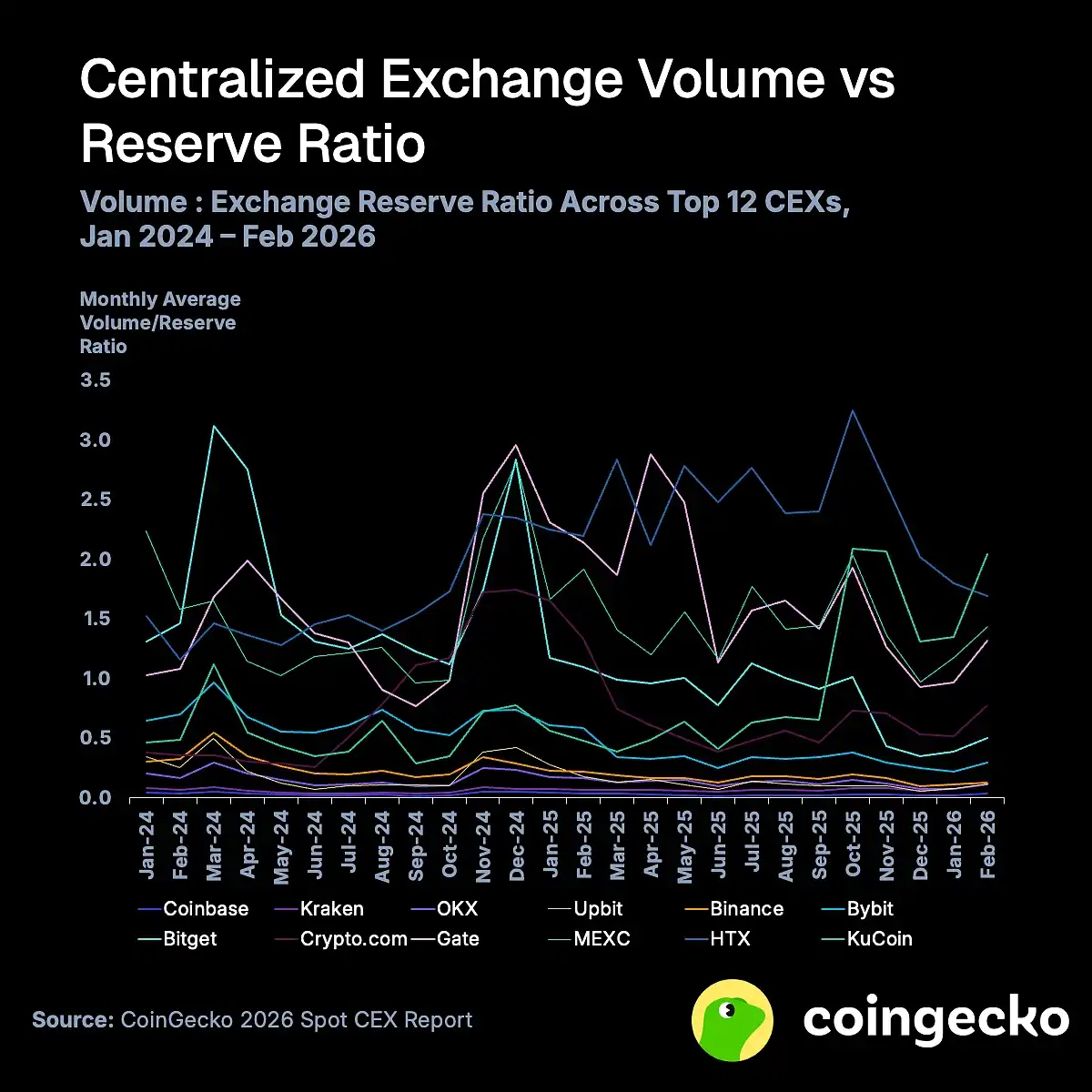
Figure: Comparison of the trading volume and reserve ratios of the top 12 CEXs
While CEXs hold significant crypto asset reserves, the efficiency of capital utilization varies greatly among platforms.
Compliant exchanges like Coinbase, Binance, and Kraken have a Volume : Reserve Ratio of around 0.1. This may be because their customer base is primarily institutional, using the platforms more for custody rather than frequent trading.
Bybit and Bitget combine high trading volumes with substantial deposit sizes, with average ratios from January 2024 to February 2026 of 0.3 and 0.5, respectively.
Exchanges with smaller reserves, such as MEXC, HTX, and KuCoin, have asset turnover rates ranging from 1.44 to 2.04. This means that users' trading volume far exceeds the exchange's held reserves, with funds circulating rapidly on the platform.
You may also like

The stablecoin positioning battle escalates: When compliance is just a ticket to entry, will USD1 become the biggest winner?

Can the CLARITY Act Become Law by July 4? Everything You Need to Know About the Final Battle

How to exit after asset tokenization?

The foundation of SpaceX's trillion-dollar valuation: Who is dividing Musk's annual capital expenditure of tens of billions?

France vs Senegal World Cup 2026: Mbappe’s New Era Begins Against a Historic Rival

SharpLink CEO: How to understand that Ethereum developers have just surpassed 1 million?

Morning Report | MiCA grace period expires on July 1; Kalshi's trading volume in the first week of the World Cup breaks $5.1 billion, setting a record

What is the connection between Huang Zheng of Pinduoduo and blockchain?

Morning Report | Prediction market platforms like Kalshi and Polymarket jointly sue Kentucky over 14.25% trading tax; Bridgewater founder discusses decision-making in the AI era: principled thinking should run parallel to AI, human insight remains irre...

If the AI bubble has already burst, who will truly remain?
Paul Graham: How to Make a Billion Dollars

After 18 years, blockchain has finally started to head towards the main channel
Claude enforces "facial recognition for household registration," starting in July, no ID card means no access?

On the day of SpaceX's IPO, the first real test of the three perpetual mechanisms

Value Distribution of Stablecoins
Galaxy Deep Dive: Is the Bitcoin Four-Year Cycle Still Valid?

SpaceX IPO, Nvidia, and Bitcoin: Why Traders Are Watching More Than Just Crypto in 2026

The other side of Musk's trillion-dollar fortune: 85% cannot be sold
The stablecoin positioning battle escalates: When compliance is just a ticket to entry, will USD1 become the biggest winner?
Can the CLARITY Act Become Law by July 4? Everything You Need to Know About the Final Battle
How to exit after asset tokenization?
The foundation of SpaceX's trillion-dollar valuation: Who is dividing Musk's annual capital expenditure of tens of billions?
France vs Senegal World Cup 2026: Mbappe’s New Era Begins Against a Historic Rival
SharpLink CEO: How to understand that Ethereum developers have just surpassed 1 million?


