
Cryptocurrency Giant Tether: Doctor Switches to Cryptocurrency, Billions in Profit Fuel Investment Craze


Original Article Title: "Global Per Capita Most Profitable Company Tether: CEO's Background as Plastic Surgeon, Accelerates Multi-Billion-Dollar Profit Diversification"
Original Article Author: Nancy, PANews
Relying solely on a team of a hundred people serving hundreds of millions of users worldwide and leveraging billions of dollars in profits, Tether, this "money printing machine," is operating with astonishing efficiency.
In the crypto world, a "money printing machine" is operating with astonishing efficiency: the stablecoin giant Tether. This team of only a hundred people serves hundreds of millions of users globally, leveraging billions of dollars in profits. And behind all of this is Giancarlo Devasini, the mastermind, who has not only transitioned from a plastic surgeon to a heavyweight in crypto finance but has also led Tether from the fringes of innovation to the center stage of the global financial arena through strategic positioning.
Today, Tether not only firmly holds the stablecoin hegemony but has also extended its reach into diversified fields such as mining, media, agriculture, and more through massive investments, embarking on an ambitious global expansion.
A Hundred-Person Team Earning Billions in Profits, Seventh Largest Buyer of US Treasury Bonds
As the world's largest stablecoin issuer, Tether has transformed from its humble beginnings as a niche financial experiment into a behemoth in the crypto industry, demonstrating astonishing profitability and market influence.
Over the past decade, Tether's publicly disclosed net profit has reached billions of dollars. Although Tether lacked detailed financial data disclosure in its early development stages, starting from 2022, the company began to fully disclose financial reports to enhance transparency. According to comprehensive public data, in just over two years from the fourth quarter of 2022 to the end of 2024, Tether's cumulative net profit reached at least $19.9 billion.
Especially in 2024, with only a streamlined team of about 150 employees, Tether achieved a total profit of over $13 billion, equivalent to an average profit of approximately $93 million per employee, making it one of the most profitable companies per capita globally, far surpassing traditional financial giants like BlackRock and even rivaling Visa in transaction volume.
In terms of profit composition, US Treasury bonds are undoubtedly Tether's core profit engine. Since the Fed began raising interest rates in 2022, Tether has invested a large amount of reserve funds in US Treasury bonds, gradually becoming one of the major buyers of US Treasury bonds. In 2024 alone, Tether purchased $33.1 billion in US Treasury bonds, making it the seventh largest buyer of US Treasury bonds, surpassing countries such as Canada, Mexico, Norway, South Korea, Germany, and Saudi Arabia. As of the end of December last year, the quarterly reserve report showed that Tether's total holdings of US Treasury bonds were valued at $94 billion.
In addition to asset allocation, the widespread adoption of the USDT stablecoin is also a key pillar of Tether's profit capture. As a USD-pegged digital asset, USDT not only surpasses the limitations of traditional financial instruments in functionality but also plays multiple roles in global financial transactions: in high inflation countries such as Venezuela and Turkey, USDT has become the preferred tool for residents to hedge against local currency depreciation and circumvent capital controls, providing an avenue for economic turmoil regions' inhabitants to seek refuge. In restricted markets and gray areas, USDT serves as a flexible and hard-to-trace financial medium.
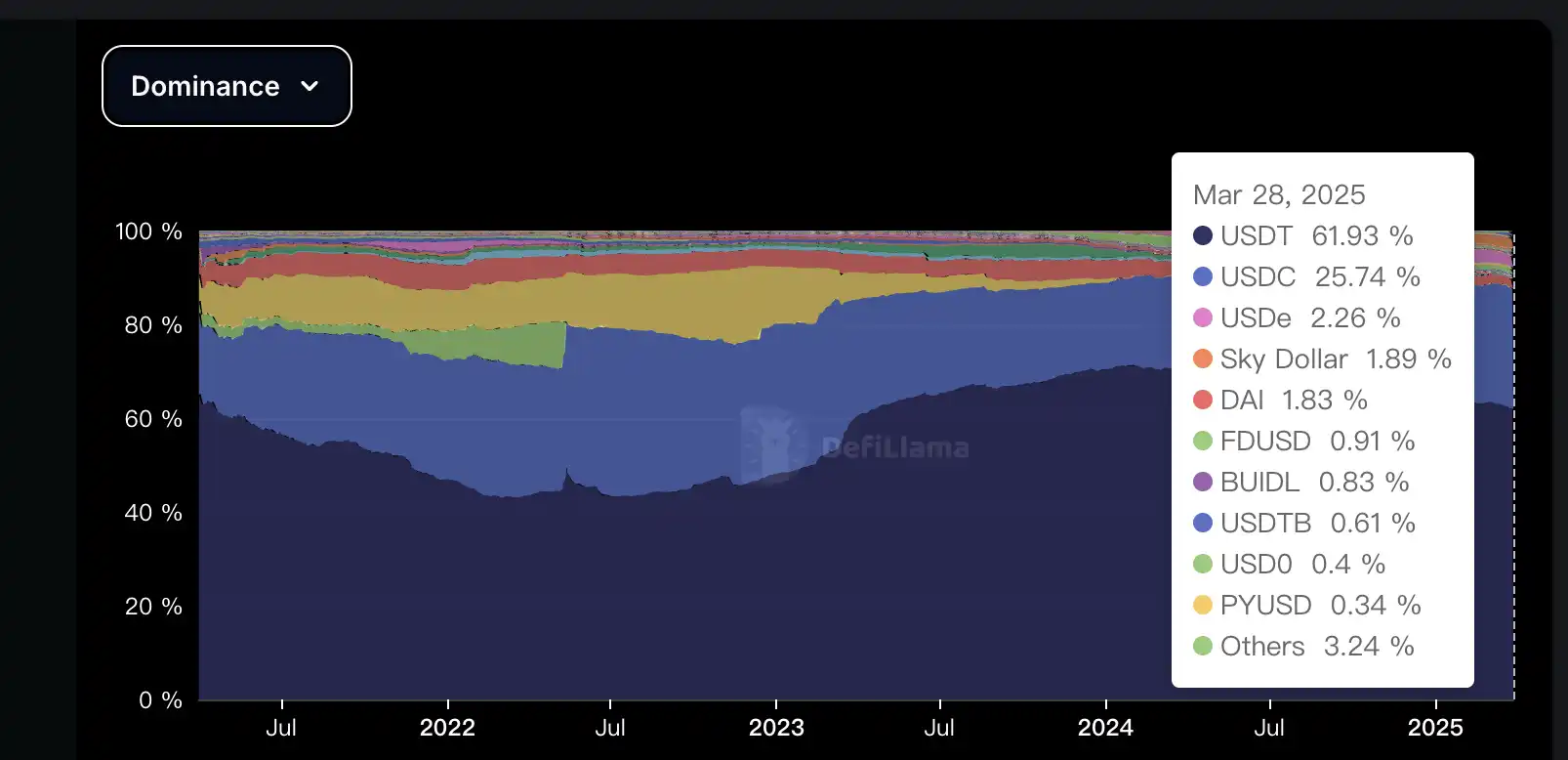
Today, USDT is leading the global stablecoin market, becoming the most widely used stablecoin. According to DeFiLlama data, as of March 28, 2025, the circulating supply of USDT has exceeded $143.7 billion, with a market cap over $144.8 billion, capturing approximately 61.9% of the stablecoin market share. Furthermore, Tether's CEO, Paolo Ardoino, revealed that the conservative estimate of USDT's global user base has surpassed 400 million, with a rapid growth trajectory, and he expects it to soon reach 1 billion.
Behind the Scenes to the Forefront, the Actual Helmsman Once an Italian Plastic Surgeon
The mastermind and actual helmsman behind this largest crypto printer are widely recognized as Tether's former CFO Devasini. According to Forbes estimates, Devasini holds 47% of the shares, making him Tether's largest shareholder with a net worth of up to $9.2 billion. However, this core figure in Tether maintains a low-key lifestyle in Lugano, Switzerland, known as a Bitcoin hub, rarely granting interviews, and even having his business card read "No title, no job, nothing."

Devasini's journey is quite legendary. According to a previous report by The Wall Street Journal, Giancarlo Devasini, born in Turin, Italy, started as a plastic surgeon and later engaged in electronics import business in Hong Kong. In 1995, Italian prosecutors accused him of involvement in operating a software piracy group, committing fraud. Subsequently, Devasini founded the tech company Solo in Italy, with annual revenue once exceeding 1 billion euros, before selling it before the 2008 financial crisis. Now, this around 60-year-old Italian has become one of the key figures in crypto finance.
It all starts in 2012 when the Bitcoin whitepaper ignited Devasini's interest in cryptocurrency. He once posted on a Bitcoin forum inquiring if anyone would be willing to buy DVDs or CDs at a price of 0.01 BTC each (about 11 cents at the time) and promised free delivery for bulk orders.
It was during that time that Devasini also met Bitfinex founder Raphael Nicolle. Leveraging his extensive business experience and network, he established key banking relationships for Bitfinex, driving the platform's internationalization, including relocating its jurisdiction to the British Virgin Islands, with headquarters in Hong Kong, gradually becoming a key figure at Bitfinex. In 2014, he co-founded Tether with Bitfinex executives and launched USDT.
Devasini was deeply involved in Tether's issuance decisions and fund management, particularly playing a key role in partnerships with major clients. For example, Alameda Research once applied for and received billions of USDT in support from Tether, with Devasini seen as the driving force behind the scenes. Bloomberg cited chat records submitted by Alameda's former CEO Caroline Ellison, showing that Devasini had told Alameda traders, "We are one big family...we will conquer the world." FTX founder SBF also publicly supported Devasini, stating, "Devasini is very proud of what he has built in Bitfinex and Tether. He is always on, not just reacting to crises or incredible opportunities, but also reacting to day-to-day operations. The criticisms of Tether that are 'without basis' seem frivolous."
Furthermore, reports have indicated that Devasini actively sought political allies to secure a regulatory "umbrella" for Tether. The Wall Street Journal previously reported that Devasini had privately indicated last year that Cantor Fitzgerald's Chairman and U.S. Secretary of Commerce Howard Lutnick would use his political influence to address the threats facing Tether. U.S. Senator Elizabeth Warren also pressured Howard Lutnick during his nomination, demanding an explanation of his relationship with Tether. It is noteworthy that Cantor manages part of Tether's reserves and holds a 5% ownership. However, Tether denied the market's claim that Lutnick's influence affects regulatory actions.
Today, as Tether expands at an astonishing pace, Devasini has also moved from behind the scenes to the strategic forefront, assuming the role of Group Chairman, focusing on macroeconomic strategies aimed at deepening USDT's global digital asset applications.
Diversification Strategy Accelerates, Mining and Media Receive Major Investments
Amid increasing regulatory scrutiny and intensified market competition, Tether is weaving a cross-industry business network through diversified investments.
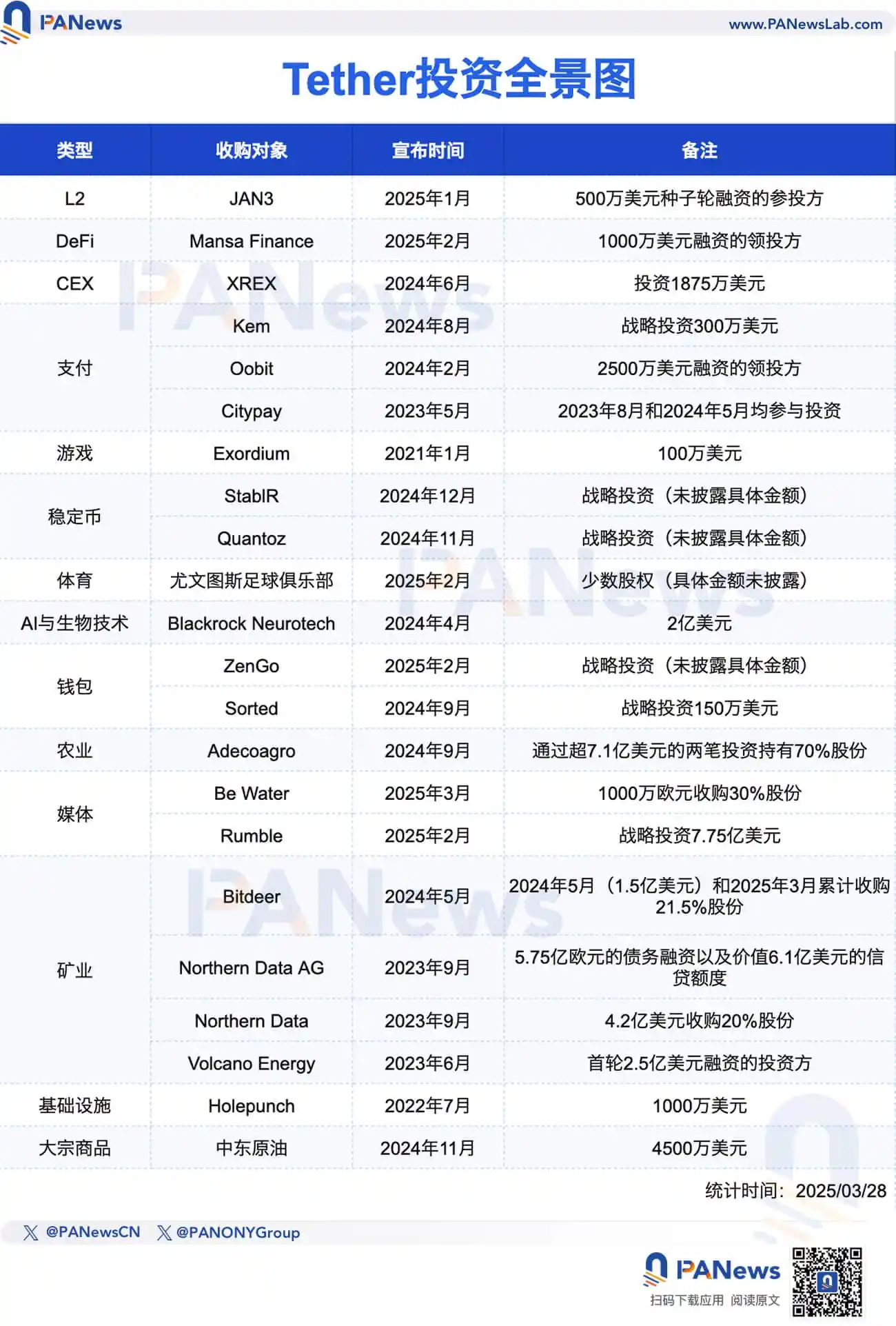
According to PANews' incomplete statistics, since 2021, Tether has publicly disclosed a total of 22 investment projects spanning various fields such as crypto, media, sports, agriculture, commodities, biotechnology, among others. Among these, the crypto sector is Tether's most core investment focus, especially in mining, payments, stablecoins, wallets, with actions being particularly frequent, accounting for over half of the overall investment count.
In terms of funding size, Tether's investment in mining is the most generous, with a cumulative investment amount exceeding $2.1 billion, far surpassing other sectors. The largest of these is the investment in the German mining company Northern Data AG, where Tether provided $575 million in debt financing and a $610 million credit line. Volcano Energy, Northern Data, and Bitdeer also received investments in the hundreds of millions. Following mining is the media industry, with Tether's total investment reaching $780 million, the majority of which went to Rumble ($775 million).
PANews previously reported that this substantial investment carries strong political undertones and resembles more of a business strategy tied to the Trump circle. Rumble has deep connections with former U.S. President Trump, often referred to as the "Trump concept stock," and even the investment fund Narya Capital Management of U.S. Vice President J.D. Vance has participated in Rumble's investments. In the agricultural sector, Tether holds up to 70% of Argentine agricultural giant Adecoagro through two investments, totaling over $710 million. Additionally, Tether acquired a majority stake in the biotechnology company Blackrock Neurotech for $200 million, with a valuation of $3.5 billion.
From a temporal perspective, between 2021 and September 2024, Tether primarily focused on crypto development, especially in mining and payment directions. Subsequently, its investment pace has markedly accelerated, and the strategic direction has become increasingly diversified, expanding from a single sector to a global layout spanning multiple industries.
Despite Tether's establishment of a robust crypto business empire through diversified investments and its dominant position in the stablecoin market, as the crypto market matures and the regulatory environment continues to evolve, Tether will face increasingly complex challenges in the future. This will depend on how it balances innovation, compliance, and expansion in the ever-changing global stage.
You may also like

Japan’s Three Megabanks Plan Joint Stablecoin Issuance in Fiscal 2026
MUFG, SMBC, and Mizuho reportedly plan to jointly issue fiat-pegged stablecoins in fiscal 2026, signaling Japan’s growing push into bank-led digital payment infrastructure.

Humanity Discloses H Token Dual-Chain Attack Details, With Losses on Ethereum and BSC Exceeding $36 Million
Humanity said the H token attack across Ethereum and BSC caused more than $36 million in losses after leaked ProxyAdmin keys enabled malicious contract upgrades and token minting.

White House Discusses CLARITY Act With Law Enforcement Ahead of Senate Vote
The White House discussed the CLARITY Act with law enforcement ahead of a Senate vote, focusing on illicit finance risks and developer protections.

$75 billion in foreign capital has fled, and South Korean retail investors have absorbed it all using leverage

Bitcoin Trading Guide 2026: Strategies for Experienced Traders

What Is XAUT and PAXG? Why Tokenized Gold Is Booming in 2026

Cryptocurrency CEXs are flocking to sell US stocks, and traditional brokerages are facing an "uninvited guest."

Will the SpaceX IPO Hurt Bitcoin? Here's What Traders Are Watching
Foreign selling in the South Korean stock market accelerates, with cumulative net sales reportedly reaching $75 billion this year
On June 9, The Kobeissi Letter, citing Goldman Sachs data, reported that global investors are selling South Korean stocks at an unusually rapid pace. In the latest trading session, foreign investors sold about $801 million worth of Kospi constituent stocks again; total foreign outflows last week reached about $10 billion, and the market has been in net foreign selling on nearly every trading day over the past month. According to the data cited in the report, foreign investors have sold about $75 billion worth of South Korean stocks so far this year. Meanwhile, South Korean retail and institutional investors together recorded roughly $69 billion in net buying over the same period, suggesting that the market’s main buying support has come from domestic capital rather than returning overseas funds. The information currently disclosed still mainly comes from The Kobeissi Letter’s retelling and Goldman Sachs data summaries, while public details on the statistical period and the specific definition of “selling” remain relatively limited.

Fortune Warns of Strategy’s Financing Structure Risks as Bitcoin Premium Narrows
Fortune warned that Strategy’s Bitcoin treasury model faces growing financing risks as MSTR’s net asset premium narrows and preferred stock dividend pressure increases.

Ferrari Challenge Le Mans: Carl Moon to Dominate in WEEX Livery

Sahara AI Responds to SAHARA’s Sharp Drop: No Contract or Product Security Issues Found, Internal Investigation Underway
Sahara AI responded to SAHARA’s 60% price drop, saying no token contract or product security issues have been found and an internal investigation is underway.

WEEX Deposit/Withdrawal Dynamic Island: Your Asset Status, Always in Sight
Scaling Crypto Derivatives: The Digital Asset Infrastructure Behind High-Volume Trading
In the fast-moving digital asset ecosystem, derivatives platforms face an extreme architectural test. High-leverage futures markets demand more than just standard security—they require absolute operational precision, zero-latency matching engines, and ironclad structural scalability, all while navigating intense market volatility.
As global platforms scale to meet these demands, the industry is shifting away from rigid, monolithic setups toward a more agile, "decoupled" infrastructure philosophy.
The Blueprint for High-Volume Copy TradingFor elite global exchanges like WEEX (founded in 2018), this architectural choice becomes critical when scaling high-volume retail features like social copy trading. When thousands of users automatically mirror the real-time strategies of elite traders simultaneously, it triggers sudden, monumental spikes in concurrent transactional volume.
To prevent execution latency or settlement bottlenecks during these peak volatility events, a platform's primary engine must remain entirely dedicated to risk management, copy-trade synchronization, and order matching.
The Architectural Rule: New-generation platforms must separate front-end user execution engines from heavy backend infrastructural overhead to eliminate operational friction.
By separating these layers, platforms can maintain complete sovereignty over their trading environments and user experiences while strategically aligning with institutional-grade infrastructure ecosystems. This strategic framework allows modern exchanges to leverage advanced Digital Asset Custody infrastructure such as Cobo’s behind the scenes, ensuring that backend wallet management scales elastically alongside trading spikes.
Capitalizing on Market Momentum and 400× LeverageIn a derivatives arena where platforms offer up to 400× leverage on perpetual contracts, capital efficiency and market agility are core business metrics. To capture market momentum, an exchange needs the ability to rapidly expand its asset offerings, supporting everything from legacy crypto assets to sudden, trending altcoins across a massive library of trading pairs.
Adopting a flexible, scalable Wallet-as-a-Service (WaaS) solution such as Cobo’s could completely rewrite the development timeline for high-growth exchanges. Instead of spending months of engineering capital building out custom backend wallet architectures for every new blockchain network, platforms can deploy localized infrastructure in days.
This agility allows platforms to instantly scale their listings to over a thousand trading pairs without compromising security or delaying time-to-market. It mirrors the exact operational advantages seen during high-velocity market events, similar to how advanced wallet infrastructure empowers platforms during sudden asset surges; allowing exchanges to pass that speed and liquidity directly to their global user base.
A Mature Foundation for GrowthThe synergy between trusted infrastructure ecosystems and global trading platforms represents the natural evolution of a maturing crypto market. As WEEX continues to scale its global spot and derivatives offerings for over 6 million users, adopting robust backend paradigms proves that platforms no longer have to compromise between cutting-edge trading velocity and uncompromised structural security.

Morning Report | BitMine increased its holdings by 126,971 ETH last week; trader Eugene announced his exit from the crypto market

Wang Chuan: How can one not feel anxious after the neighbor Old Wang made thirty times profit by investing in storage stocks? (Seven) - A quarter-century cycle

Get Paid to Onboard? Try WEEX’s New Homepage with Rewards for Registration, Deposit & Trade
WEEX Custom Layout: Build Your Perfect Trading Workspace in Seconds
Japan’s Three Megabanks Plan Joint Stablecoin Issuance in Fiscal 2026
MUFG, SMBC, and Mizuho reportedly plan to jointly issue fiat-pegged stablecoins in fiscal 2026, signaling Japan’s growing push into bank-led digital payment infrastructure.
Humanity Discloses H Token Dual-Chain Attack Details, With Losses on Ethereum and BSC Exceeding $36 Million
Humanity said the H token attack across Ethereum and BSC caused more than $36 million in losses after leaked ProxyAdmin keys enabled malicious contract upgrades and token minting.
White House Discusses CLARITY Act With Law Enforcement Ahead of Senate Vote
The White House discussed the CLARITY Act with law enforcement ahead of a Senate vote, focusing on illicit finance risks and developer protections.
$75 billion in foreign capital has fled, and South Korean retail investors have absorbed it all using leverage
Bitcoin Trading Guide 2026: Strategies for Experienced Traders
What Is XAUT and PAXG? Why Tokenized Gold Is Booming in 2026


