
From DOGE to GHIBLI, What Should the Next Level of Meme Coins Look Like?

Original Article Title: Social currencies are the future of memecoins
Original Article Author: LucaNetz, Pudgy Penguins NFT CEO
Original Article Translation: Deep Translation Agency
Editor's Note: The article focuses on the rise of Meme coins and their potential and limitations. The author believes that while Meme coins serve as a unique vehicle for cryptocurrency speculation, their development is hindered by a lack of innovation, stagnation, and reliance solely on hype. The article proposes that Meme coins should evolve into "social currencies" to drive the development of the crypto industry. Social currencies are the evolved form of Meme coins, with their success depending on execution rather than luck, and they may ultimately lead a new transformation in the crypto space.
The following is the original content (slightly reorganized for better readability):
The past 18 months in the cryptocurrency market have been like a rollercoaster, and in this chaos, we have witnessed the rise of Meme coins. While Meme coins are not a new phenomenon—in fact, they are one of the oldest forms of cryptocurrency—they have once again proven themselves to be the preferred vessel for participating in the most unique mechanism (speculation) of cryptocurrency.
Although Meme coins are fundamentally pure and almost artistic, they also have a dark side. No, the issue is not with insiders or small groups—this is a common ailment plaguing the entire cryptocurrency space. In my view, the real issue lies in a lack of effort, a failure to seize the moment, and people being stuck in a rut when it comes to building Meme coins. Perhaps I am too naive, but I refuse to accept that Meme coins end here—at least I hope they don't.
I deeply believe that the Trojan horse of cryptocurrency adoption is intellectual property (IP), as it can establish credibility in a field lacking a trust hierarchy, and Meme coins, like NFTs, are a form of IP. Meme coins have a huge opportunity to drive the development of the crypto industry by delving into the minds of ordinary people. However, they have not tapped into the full potential of transcending the native role of crypto; instead, they are stagnant in their path to exceed, lacking originality and being mundane. I am concerned that if they remain as they are, the drawbacks will outweigh the benefits. For this category to thrive, Meme coins must evolve, and I strongly believe that the direction of evolution is to become social currencies—tokens that go beyond lazy pumps and dumps, transforming into scalable, memorable, and beloved IPs.
My proposition is not to replace Meme coins with social currencies but to add a final stage to their growth roadmap. Meme coins must graduate from on-chain meaningless images to become social currencies that can drive the development of the crypto industry, being productive and perceptive. I believe there are already tokens in this category. This article will discuss the current state of Meme coins, why successful projects should evolve into social currencies, and the impact of social currencies on the crypto space.
First of All, What Is a Social Currency?
A social currency is a tokenized asset that represents value within a specific community, often used to incentivize participation, reward contributions, and enhance brand or community loyalty. It operates similarly to traditional currency, but its value is derived from social interaction, reputation, and influence.
In simple terms, a social currency is a fundamentally sound Meme coin — it is progressive, insightful, focused on nurturing a community capable of sustaining a viral effect, rather than extracting value from short-lived hype.
Meme Coin vs. Social Currency
Meme coins do not create viral effects — they monetize viral effects, squeezing out popularity until it fades away. On the other hand, social currencies are insightful, actively driving their intellectual property through various media, collaborations, and integrations to consistently generate viral effects.
Typical Lifecycle of a Meme Coin:
· Idea → Token Launch → Community Cultivation → Community Advocacy Narrative → Narrative Demise → Community Dissolution
Lifecycle of a Social Currency:
· Idea → Token Launch → Community Cultivation → Community Advocacy Narrative → Brand Establishment → Brand Expansion → Ecosystem Building → Global Adoption and Recognition as Currency
In my view, all social currencies start as Meme coins initially, but with accumulated momentum, they must evolve into social currencies. The diagram below accurately illustrates this process.
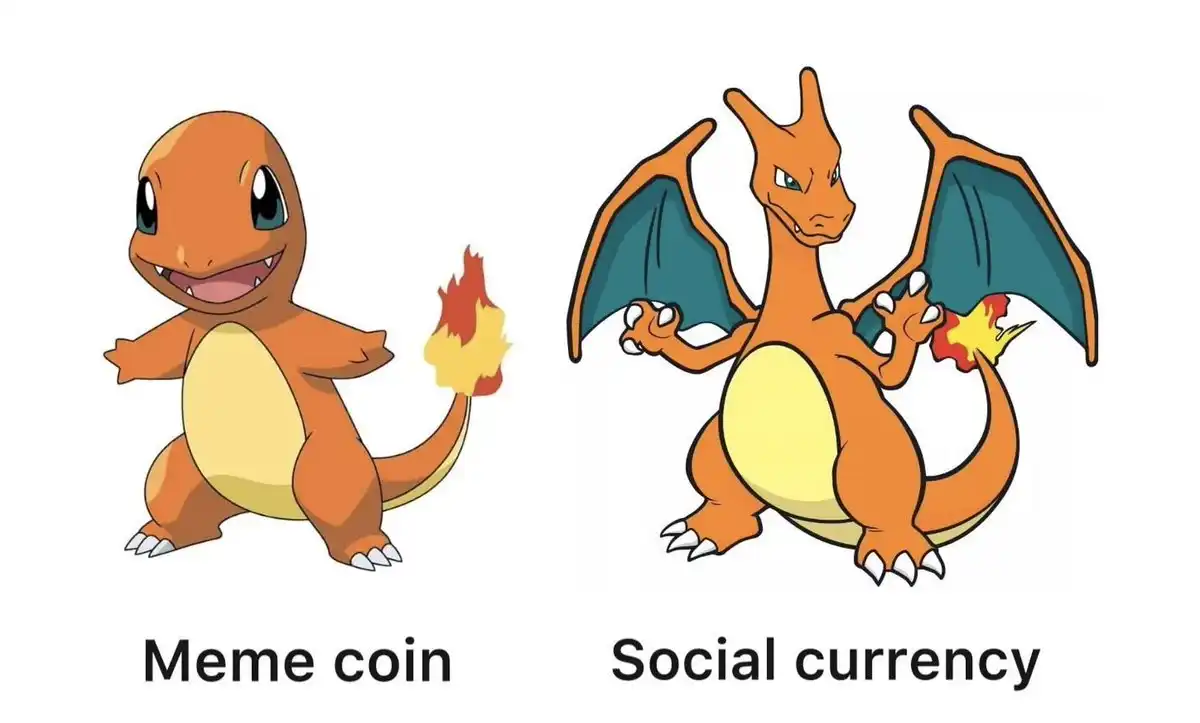
I love this diagram because it shows that social currency is not meant to replace Meme coins but is their evolutionary form. To me, a social currency is a Meme coin with real value backing. Anyone can issue a Meme coin, but only the best can inject real value into it.
If you believe that liquid crypto assets will primarily belong to the retail asset class, then you are betting on Meme coins and their success. If you believe that institutional capital will eventually flow into altcoins, then you must expect fundamentals to prevail. Social currency combines the advantages of both — it has the retail appeal of Meme coins and the fun factor to attract institutional participation. In my opinion, social currency integrates the essence of Meme coins and utility tokens.
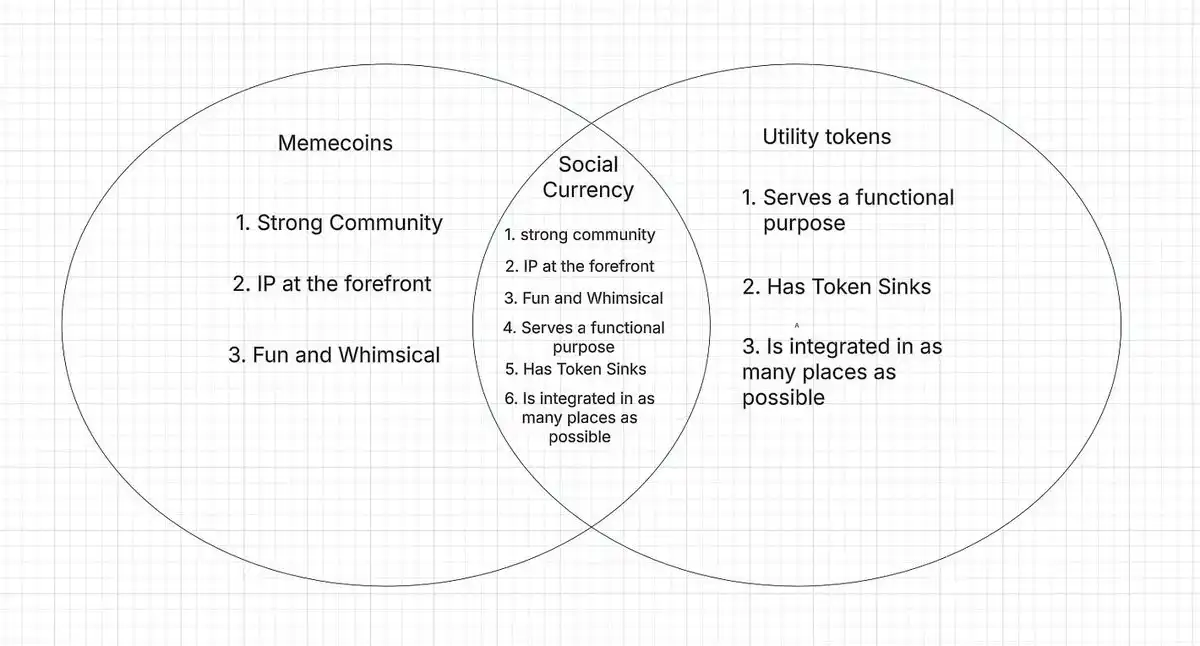
When dissecting the flaws of Meme coins, it is evident that they could be more potent, but we have allowed societal consensus to convince us that "Meme coins are supposed to be useless, it has always been that way." I personally refuse to accept this as the future standard for this field. To understand my frustration, we must first break down the current factors constraining Meme coins and how social currencies address these issues.
Flaws of Meme Coins
· Meme coins are prone to rug pulls: momentum fades, leading to a loss of driving force.
· Stigmatization: 99% of speculators incur losses as meme coins are not intended for long-term holding.
· PvP Mode: Designed for quick gains, turning into a game of musical chairs among existing holders.
· Lack of infrastructure to attract new users.
· Apart from a speculative narrative, meme coins lack genuine faith support — they lack fundamentals.
· Success often relies on fantasy and luck.
Advantages of Social Tokens
· Perceptiveness: Ability to both create and capture trends, maintaining sustained relevance.
· New narrative: Combining the longevity of meme coins with genuine fundamental growth support, suitable for long-term holding.
· PvE Mode: Aimed at driving industry development and attracting new users.
· Continuously creating demand through content strategies, brand partnerships, and IP growth.
· Building real-world assets beyond the industry to enhance holder identification and belief — establishing genuine faith foundations.
· Success is not reliant on luck or narrative but is supported by genuine fundamentals.
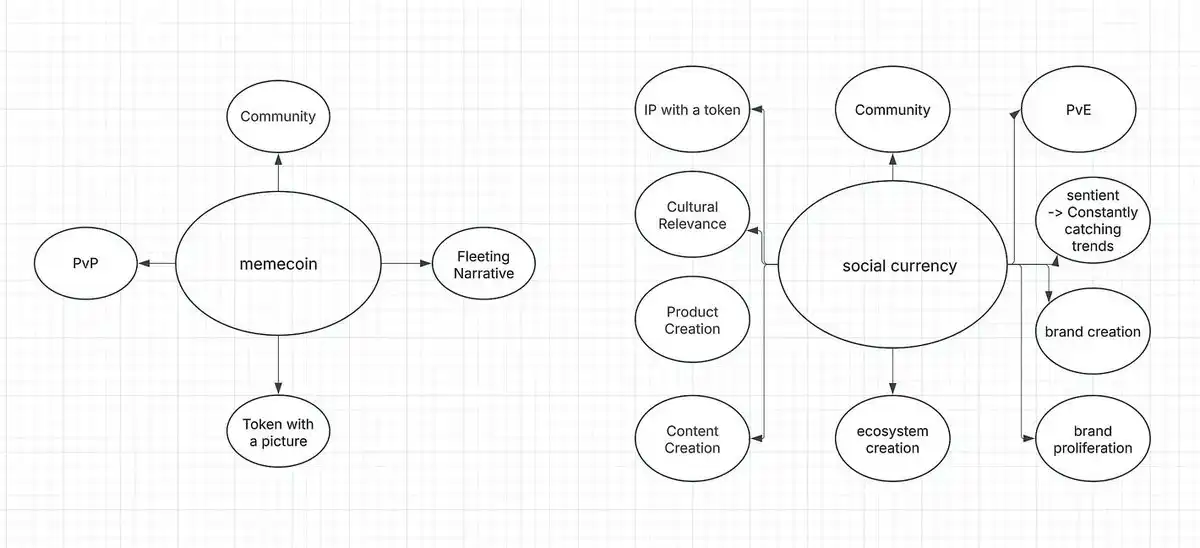
Perceptiveness vs. Non-Perceptiveness
For traders and investors, the core difference between meme coins and social tokens lies in perceptiveness — the ability to maintain continuous relevance. Social tokens possess perceptiveness, unlike meme coins, which is a key focus for traders. Perceptiveness = relevance = attention = potential energy. Unless you are a crypto legend (such as DOGE), anything non-perceptive will eventually fade away.
By this point, some may think, "I don't want meme coins to carry any execution risk."
This psychological warfare began with 2020 NFT art collectors, and I am surprised we have continued this narrative. My counterargument is simple: anything without execution risk solely relies on luck. Execution risk is the only risk worth taking. If your position does not rely on execution, I can say with 999,999 out of 1 million certainties that your performance will be inferior to those betting on execution (although I still wish you good luck).
The Future of Social Tokens
To achieve its true potential, a Meme coin needs to evolve into a social currency in its final chapter. Tokens that create culture, nurture deep community ties, and integrate real-world utility will define the new crypto era. Shifting from a stagnant speculative asset to a dynamic participatory ecosystem is not only necessary but also inevitable.
Now the question you need to ponder is: Who will lead this transformation?
You may also like

Japan’s Three Megabanks Plan Joint Stablecoin Issuance in Fiscal 2026
MUFG, SMBC, and Mizuho reportedly plan to jointly issue fiat-pegged stablecoins in fiscal 2026, signaling Japan’s growing push into bank-led digital payment infrastructure.

Humanity Discloses H Token Dual-Chain Attack Details, With Losses on Ethereum and BSC Exceeding $36 Million
Humanity said the H token attack across Ethereum and BSC caused more than $36 million in losses after leaked ProxyAdmin keys enabled malicious contract upgrades and token minting.

White House Discusses CLARITY Act With Law Enforcement Ahead of Senate Vote
The White House discussed the CLARITY Act with law enforcement ahead of a Senate vote, focusing on illicit finance risks and developer protections.

$75 billion in foreign capital has fled, and South Korean retail investors have absorbed it all using leverage

Bitcoin Trading Guide 2026: Strategies for Experienced Traders

What Is XAUT and PAXG? Why Tokenized Gold Is Booming in 2026

Cryptocurrency CEXs are flocking to sell US stocks, and traditional brokerages are facing an "uninvited guest."

Will the SpaceX IPO Hurt Bitcoin? Here's What Traders Are Watching
Foreign selling in the South Korean stock market accelerates, with cumulative net sales reportedly reaching $75 billion this year
On June 9, The Kobeissi Letter, citing Goldman Sachs data, reported that global investors are selling South Korean stocks at an unusually rapid pace. In the latest trading session, foreign investors sold about $801 million worth of Kospi constituent stocks again; total foreign outflows last week reached about $10 billion, and the market has been in net foreign selling on nearly every trading day over the past month. According to the data cited in the report, foreign investors have sold about $75 billion worth of South Korean stocks so far this year. Meanwhile, South Korean retail and institutional investors together recorded roughly $69 billion in net buying over the same period, suggesting that the market’s main buying support has come from domestic capital rather than returning overseas funds. The information currently disclosed still mainly comes from The Kobeissi Letter’s retelling and Goldman Sachs data summaries, while public details on the statistical period and the specific definition of “selling” remain relatively limited.

Fortune Warns of Strategy’s Financing Structure Risks as Bitcoin Premium Narrows
Fortune warned that Strategy’s Bitcoin treasury model faces growing financing risks as MSTR’s net asset premium narrows and preferred stock dividend pressure increases.

Ferrari Challenge Le Mans: Carl Moon to Dominate in WEEX Livery

Sahara AI Responds to SAHARA’s Sharp Drop: No Contract or Product Security Issues Found, Internal Investigation Underway
Sahara AI responded to SAHARA’s 60% price drop, saying no token contract or product security issues have been found and an internal investigation is underway.

WEEX Deposit/Withdrawal Dynamic Island: Your Asset Status, Always in Sight
Scaling Crypto Derivatives: The Digital Asset Infrastructure Behind High-Volume Trading
In the fast-moving digital asset ecosystem, derivatives platforms face an extreme architectural test. High-leverage futures markets demand more than just standard security—they require absolute operational precision, zero-latency matching engines, and ironclad structural scalability, all while navigating intense market volatility.
As global platforms scale to meet these demands, the industry is shifting away from rigid, monolithic setups toward a more agile, "decoupled" infrastructure philosophy.
The Blueprint for High-Volume Copy TradingFor elite global exchanges like WEEX (founded in 2018), this architectural choice becomes critical when scaling high-volume retail features like social copy trading. When thousands of users automatically mirror the real-time strategies of elite traders simultaneously, it triggers sudden, monumental spikes in concurrent transactional volume.
To prevent execution latency or settlement bottlenecks during these peak volatility events, a platform's primary engine must remain entirely dedicated to risk management, copy-trade synchronization, and order matching.
The Architectural Rule: New-generation platforms must separate front-end user execution engines from heavy backend infrastructural overhead to eliminate operational friction.
By separating these layers, platforms can maintain complete sovereignty over their trading environments and user experiences while strategically aligning with institutional-grade infrastructure ecosystems. This strategic framework allows modern exchanges to leverage advanced Digital Asset Custody infrastructure such as Cobo’s behind the scenes, ensuring that backend wallet management scales elastically alongside trading spikes.
Capitalizing on Market Momentum and 400× LeverageIn a derivatives arena where platforms offer up to 400× leverage on perpetual contracts, capital efficiency and market agility are core business metrics. To capture market momentum, an exchange needs the ability to rapidly expand its asset offerings, supporting everything from legacy crypto assets to sudden, trending altcoins across a massive library of trading pairs.
Adopting a flexible, scalable Wallet-as-a-Service (WaaS) solution such as Cobo’s could completely rewrite the development timeline for high-growth exchanges. Instead of spending months of engineering capital building out custom backend wallet architectures for every new blockchain network, platforms can deploy localized infrastructure in days.
This agility allows platforms to instantly scale their listings to over a thousand trading pairs without compromising security or delaying time-to-market. It mirrors the exact operational advantages seen during high-velocity market events, similar to how advanced wallet infrastructure empowers platforms during sudden asset surges; allowing exchanges to pass that speed and liquidity directly to their global user base.
A Mature Foundation for GrowthThe synergy between trusted infrastructure ecosystems and global trading platforms represents the natural evolution of a maturing crypto market. As WEEX continues to scale its global spot and derivatives offerings for over 6 million users, adopting robust backend paradigms proves that platforms no longer have to compromise between cutting-edge trading velocity and uncompromised structural security.

Morning Report | BitMine increased its holdings by 126,971 ETH last week; trader Eugene announced his exit from the crypto market

Wang Chuan: How can one not feel anxious after the neighbor Old Wang made thirty times profit by investing in storage stocks? (Seven) - A quarter-century cycle

Get Paid to Onboard? Try WEEX’s New Homepage with Rewards for Registration, Deposit & Trade
WEEX Custom Layout: Build Your Perfect Trading Workspace in Seconds
Japan’s Three Megabanks Plan Joint Stablecoin Issuance in Fiscal 2026
MUFG, SMBC, and Mizuho reportedly plan to jointly issue fiat-pegged stablecoins in fiscal 2026, signaling Japan’s growing push into bank-led digital payment infrastructure.
Humanity Discloses H Token Dual-Chain Attack Details, With Losses on Ethereum and BSC Exceeding $36 Million
Humanity said the H token attack across Ethereum and BSC caused more than $36 million in losses after leaked ProxyAdmin keys enabled malicious contract upgrades and token minting.
White House Discusses CLARITY Act With Law Enforcement Ahead of Senate Vote
The White House discussed the CLARITY Act with law enforcement ahead of a Senate vote, focusing on illicit finance risks and developer protections.
$75 billion in foreign capital has fled, and South Korean retail investors have absorbed it all using leverage
Bitcoin Trading Guide 2026: Strategies for Experienced Traders
What Is XAUT and PAXG? Why Tokenized Gold Is Booming in 2026


