
Key Market Intelligence on March 25, How Much Did You Miss?





精选要闻
1.PumpSwap 单日成交量突破 4.5 亿美元,已占据 Solana 生态份额的 19.2%
2.PancakeSwap 周成交额 130.7 亿美元逆势上涨 17.65%,位列全网 DEX 协议第一
3.QCP:4 月历来是风险资产表现良好的时期,通胀数据将成为关键催化剂
4.Matrixport:比特币与纳指相关性触及极端水平,或将迎来走势分化
5.美股盘前特朗普媒体科技集团最高涨幅 14.61%,其余加密货币股票普跌
Trending 话题
来源:Overheard on CT(tg:@overheardonct),Kaito
市场动态
BERA:今天,BERA 受到了广泛关注,原因是 Berachain 推出了「流动性证明(PoL)」系统,这是其链上治理和 DeFi 生态的重要里程碑。PoL 允许用户锁定流动性以获得治理权,增强去中心化决策能力。这一发布引发了市场对 BERA 生态的热烈讨论,包括大量投资和激励资金的流入。此外,用户期待通过 PoL 系统赚取 BGT 代币收益,而验证者在激励分配中的关键角色也成为关注焦点。同时,Berachain 生态内多个项目的整合和合作进一步推动了市场对 BERA 的热情。
PARTICLENETWORK:关于 Particle Network 的主要讨论集中在其即将举行的代币生成事件(TGE)和在 Binance、OKX 等主要交易所上市。社区对参与测试网的用户可能获得空投充满期待,同时 $PARTI 代币将在 2025 年 3 月 25 日上线,市场对其表现抱有极大兴趣。讨论围绕代币分配流程以及通过 Binance 钱包参与 TGE 的优势展开。此外,该项目独特的链抽象(Chain Abstraction)技术也被广泛关注,预计将提升用户在多链环境下的体验。
NILLION:由于主网正式上线以及 $NIL 代币在 Binance、KuCoin 和 MEXC 等交易所上市,Nillion 今天热度激增。其「盲计算(Blind Compute)」技术因能够在加密数据上进行安全计算而受到广泛赞誉。社区对 Nillion 在现实世界中的应用潜力感到兴奋,许多用户表达了看涨情绪,并分享了空投体验。该项目对隐私保护和 AI 集成的关注,也被认为是其人气持续增长的关键因素。
PROPC:PROPC 因其在现实资产(RWA)代币化领域,尤其是在房地产领域的应用,吸引了大量关注。该项目与 Chainlink 和 Clearpool 等知名平台建立了战略合作伙伴关系。过去 14 天内,PROPC 价格上涨 55%,市场兴趣激增。讨论主要围绕其增长潜力展开,许多投资者对其未来持看涨态度,认为它是 RWA 赛道的重要参与者。
精选文章
1.《高盛前执行董事,打造了一个合规的 CeDeFi 交易平台》
文章指出加密交易平台正迎来「先合规再增长」时代,Binance、Bybit 等因合规问题调整策略。GRVT 作为 CeDeFi 平台,在百慕大、迪拜等地获取合规牌照,并整合 CEX 与 DEX 优点。其链上与链下管理结合零知识证明技术,吸引众多机构合作,或成为行业新焦点。
2.《Canary Capital 频频提交 ETF 申请,山寨 ETF 申请成为变相广告生意?》
本文介绍了 WLFI 在 BSC 上推出美元稳定币 USD1,借助特朗普家族光环引发市场关注。CZ 转发后,社区创建同名代币引发炒作,随后价格大跌。WLFI 希望借稳定币转型 DeFi,市场质疑其是否为「收割」项目。政策监管推进下,USD1 未来仍存不确定性。
链上数据
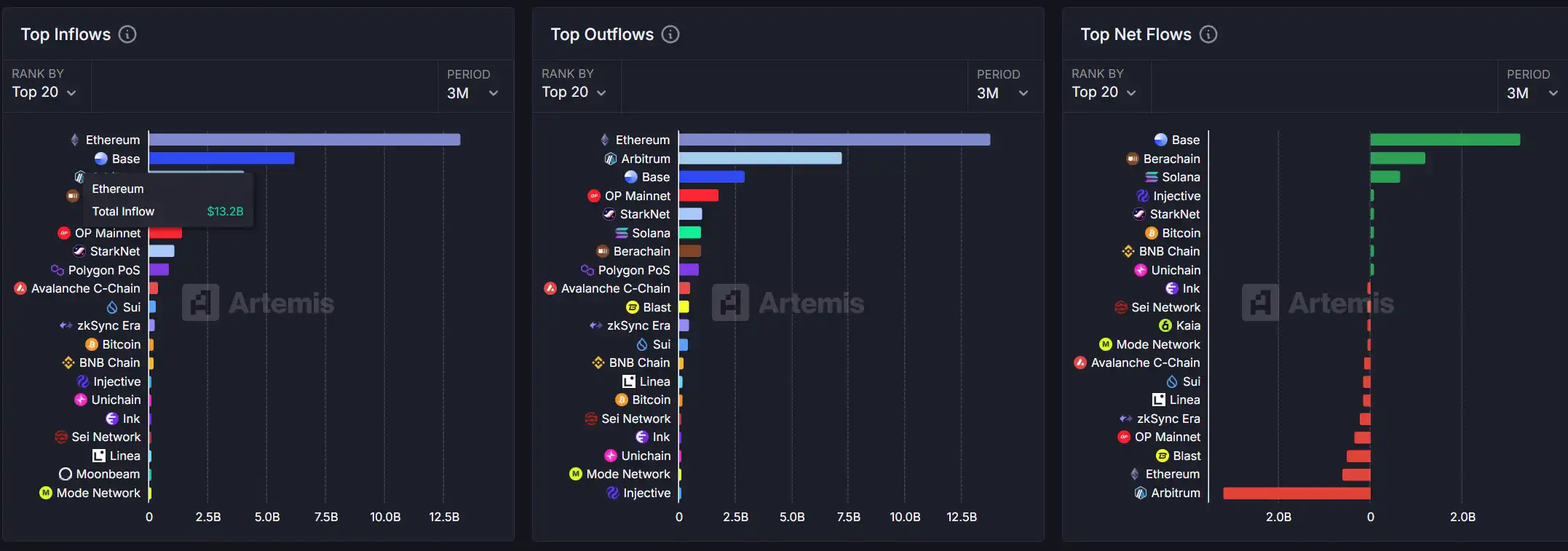
3 月 25 日当周链上资金流动情况
You may also like

Cryptocurrency CEXs are flocking to sell US stocks, and traditional brokerages are facing an "uninvited guest."

Will the SpaceX IPO Hurt Bitcoin? Here's What Traders Are Watching
Foreign selling in the South Korean stock market accelerates, with cumulative net sales reportedly reaching $75 billion this year
On June 9, The Kobeissi Letter, citing Goldman Sachs data, reported that global investors are selling South Korean stocks at an unusually rapid pace. In the latest trading session, foreign investors sold about $801 million worth of Kospi constituent stocks again; total foreign outflows last week reached about $10 billion, and the market has been in net foreign selling on nearly every trading day over the past month. According to the data cited in the report, foreign investors have sold about $75 billion worth of South Korean stocks so far this year. Meanwhile, South Korean retail and institutional investors together recorded roughly $69 billion in net buying over the same period, suggesting that the market’s main buying support has come from domestic capital rather than returning overseas funds. The information currently disclosed still mainly comes from The Kobeissi Letter’s retelling and Goldman Sachs data summaries, while public details on the statistical period and the specific definition of “selling” remain relatively limited.

Fortune Warns of Strategy’s Financing Structure Risks as Bitcoin Premium Narrows
Fortune warned that Strategy’s Bitcoin treasury model faces growing financing risks as MSTR’s net asset premium narrows and preferred stock dividend pressure increases.

Ferrari Challenge Le Mans: Carl Moon to Dominate in WEEX Livery

Sahara AI Responds to SAHARA’s Sharp Drop: No Contract or Product Security Issues Found, Internal Investigation Underway
Sahara AI responded to SAHARA’s 60% price drop, saying no token contract or product security issues have been found and an internal investigation is underway.

WEEX Deposit/Withdrawal Dynamic Island: Your Asset Status, Always in Sight

Scaling Crypto Derivatives: The Digital Asset Infrastructure Behind High-Volume Trading
In the fast-moving digital asset ecosystem, derivatives platforms face an extreme architectural test. High-leverage futures markets demand more than just standard security—they require absolute operational precision, zero-latency matching engines, and ironclad structural scalability, all while navigating intense market volatility.
As global platforms scale to meet these demands, the industry is shifting away from rigid, monolithic setups toward a more agile, "decoupled" infrastructure philosophy.
The Blueprint for High-Volume Copy TradingFor elite global exchanges like WEEX (founded in 2018), this architectural choice becomes critical when scaling high-volume retail features like social copy trading. When thousands of users automatically mirror the real-time strategies of elite traders simultaneously, it triggers sudden, monumental spikes in concurrent transactional volume.
To prevent execution latency or settlement bottlenecks during these peak volatility events, a platform's primary engine must remain entirely dedicated to risk management, copy-trade synchronization, and order matching.
The Architectural Rule: New-generation platforms must separate front-end user execution engines from heavy backend infrastructural overhead to eliminate operational friction.
By separating these layers, platforms can maintain complete sovereignty over their trading environments and user experiences while strategically aligning with institutional-grade infrastructure ecosystems. This strategic framework allows modern exchanges to leverage advanced Digital Asset Custody infrastructure such as Cobo’s behind the scenes, ensuring that backend wallet management scales elastically alongside trading spikes.
Capitalizing on Market Momentum and 400× LeverageIn a derivatives arena where platforms offer up to 400× leverage on perpetual contracts, capital efficiency and market agility are core business metrics. To capture market momentum, an exchange needs the ability to rapidly expand its asset offerings, supporting everything from legacy crypto assets to sudden, trending altcoins across a massive library of trading pairs.
Adopting a flexible, scalable Wallet-as-a-Service (WaaS) solution such as Cobo’s could completely rewrite the development timeline for high-growth exchanges. Instead of spending months of engineering capital building out custom backend wallet architectures for every new blockchain network, platforms can deploy localized infrastructure in days.
This agility allows platforms to instantly scale their listings to over a thousand trading pairs without compromising security or delaying time-to-market. It mirrors the exact operational advantages seen during high-velocity market events, similar to how advanced wallet infrastructure empowers platforms during sudden asset surges; allowing exchanges to pass that speed and liquidity directly to their global user base.
A Mature Foundation for GrowthThe synergy between trusted infrastructure ecosystems and global trading platforms represents the natural evolution of a maturing crypto market. As WEEX continues to scale its global spot and derivatives offerings for over 6 million users, adopting robust backend paradigms proves that platforms no longer have to compromise between cutting-edge trading velocity and uncompromised structural security.

Morning Report | BitMine increased its holdings by 126,971 ETH last week; trader Eugene announced his exit from the crypto market

Wang Chuan: How can one not feel anxious after the neighbor Old Wang made thirty times profit by investing in storage stocks? (Seven) - A quarter-century cycle

Get Paid to Onboard? Try WEEX’s New Homepage with Rewards for Registration, Deposit & Trade

WEEX Custom Layout: Build Your Perfect Trading Workspace in Seconds

See “Buy Walls” & “Sell Walls” Instantly: WEEX Launches the Depth Chart for Smarter Trades

What Is Quick Trade on WEEX? 2 Ways WEEX Ends Chart-Panel Jumping
Morning News | Five major virtual asset platforms in South Korea have experienced 57 incidents of hacking and system failures in six years; Grayscale submits registration application for Canton ETF

Should we escape the peak? The principle of the tail-end market in the stock market

RootData: May 2026 Cryptocurrency Exchange Transparency Research Report

Founder of Baixing.com: My Experience with Claude Code in Fourteen Points
Cryptocurrency CEXs are flocking to sell US stocks, and traditional brokerages are facing an "uninvited guest."
Will the SpaceX IPO Hurt Bitcoin? Here's What Traders Are Watching
Foreign selling in the South Korean stock market accelerates, with cumulative net sales reportedly reaching $75 billion this year
On June 9, The Kobeissi Letter, citing Goldman Sachs data, reported that global investors are selling South Korean stocks at an unusually rapid pace. In the latest trading session, foreign investors sold about $801 million worth of Kospi constituent stocks again; total foreign outflows last week reached about $10 billion, and the market has been in net foreign selling on nearly every trading day over the past month. According to the data cited in the report, foreign investors have sold about $75 billion worth of South Korean stocks so far this year. Meanwhile, South Korean retail and institutional investors together recorded roughly $69 billion in net buying over the same period, suggesting that the market’s main buying support has come from domestic capital rather than returning overseas funds. The information currently disclosed still mainly comes from The Kobeissi Letter’s retelling and Goldman Sachs data summaries, while public details on the statistical period and the specific definition of “selling” remain relatively limited.
Fortune Warns of Strategy’s Financing Structure Risks as Bitcoin Premium Narrows
Fortune warned that Strategy’s Bitcoin treasury model faces growing financing risks as MSTR’s net asset premium narrows and preferred stock dividend pressure increases.
Ferrari Challenge Le Mans: Carl Moon to Dominate in WEEX Livery
Sahara AI Responds to SAHARA’s Sharp Drop: No Contract or Product Security Issues Found, Internal Investigation Underway
Sahara AI responded to SAHARA’s 60% price drop, saying no token contract or product security issues have been found and an internal investigation is underway.


