
Potential Airdrop Expectation + High-Yield Staking, Taking Stock of the Top 10 New Projects Worth Watching Recently



Original Article Title: "Potential Airdrop Expectation + High-Yield Staking, Checklist of 10 New Projects Worth Watching Recently"
Original Article Author: CryptoLeo, Odaily Planet Daily
Life is not easy, and hodlers are crying. With the current market sentiment being tepid, it may be a good time to shift focus to new projects. Odaily Planet Daily has compiled a list of projects worth paying attention to recently, categorized into two main groups: DeFi and projects with recent funding announcements.
Friendly reminder: Participating in new projects involves certain risks. It is recommended to exercise risk management and due diligence. It is not advisable to invest a large amount of funds in the initial stages.
DeFi Category
1. Stout
Project Overview:
Stout is the native lending protocol on Sonic, with a current Total Value Locked (TVL) of $4 million. It is currently possible to borrow the protocol's stablecoin, DUSX, by providing wS, stS, wETH, veSTTX. The protocol consists of four tokens:
· STTX: Provides support for the protocol, equivalent to Stout's base token, with a token deflation and burn mechanism. Long-term holding is not recommended, and the best approach is to lock it as veSTTX;
· DUSX: Over-collateralized stablecoin, can be exchanged 1:1 with USDC through the protocol's PSM;
· veSTTX: Governance token and collateral asset, providing a 98% loan-to-value (LTV) ratio;
· stDUSX: Staking token, earning 75% of the protocol's revenue, with a staking APY of 24.47%.
When engaging in lending projects, it is important to pay attention to the project's liquidation threshold. On Stout, each collateral type has a different maximum ratio. Its liquidation mechanism involves when a Collateral Debt Position (CDP) reaches a collateral type's liquidation threshold, the user still repays the debt in exchange for some collateral.
Reasons to Watch: Part of Sonic ecosystem's DeFi protocol; high loan-to-value (LTV) ratio; stDUSX staking APY of 24.47%.
2. Dexari
Project Overview:
Dexari is a self-custodial, permissionless on-chain DEX built on Hyperliquid. It has launched an IOS Testflight version of the app (requires an invite code to join Early Access) and has already released features such as the contract market, token charting tool, and advanced orders. The project does not require KYC, supports multi-chain with unified cross-chain balances, and will soon introduce spot trading, fiat onramp/offramp, token tracking, and alert features. Additionally, Dexari will introduce staking and mining functions in the future. Early users can earn points in the Dexari Points Preseason to receive rewards after Early Access ends.
Reasons to Follow: Built on Hyperliquid with deep liquidity; App-based DEX that could potentially replace mobile CEX; Early access with rewards available, co-founded by Zac.hl, a former Binance.US employee.
3. flyingtulip
Project Overview:
flyingtulip is a one-stop DeFi platform launched by Andre Cronje, offering various functions such as trading, liquidity pools, and lending, all consolidated in a single AMM protocol. This setup eliminates liquidity fragmentation issues as it combines spot, leverage, and perpetual aspects in one protocol without the need to interact with different protocols. The official claim is that this product can reduce impermanent loss by 42%, increase LP returns by 9x, and enhance capital efficiency by 85% compared to other DEX protocols. For more details, refer to the article "The Man who Understands DeFi the Best, Bringing His New Project FlyingTulip."
Reasons to Follow: AC as the founder, 0.02% trading fee, 9x LP returns, and 85% capital efficiency.
4. Multipli.fi
Project Overview:
Multipli.fi is a multi-chain yield generation protocol with a TVL of $85.6 million. It is backed by Pantera Capital, Sequoia Capital, Elevation Capital, and The Spartan Group. The protocol utilizes a delta-neutral arbitrage strategy in the spot and futures markets to provide high yields for native tokens and RWA assets.
The project currently supports the BNB Chain and Ethereum, with deposits supporting USDT and USDC. In the future, it will support BTC, ETH, SOl, and other tokens. Users can deposit stablecoins into the project to earn high yields and ORB tokens (click the invite link to register, invitation code: 7T46G). Currently, the APY for USDC deposits is 21.19%, and for USDT, it is 21.21%. Deposits and ORB rewards take some time to complete. Bonus ORB rewards can only be received after depositing on Multipli.fi for 30 days. The first season (50% ORB weight) deposit ORB activity is almost over, and current deposits can participate in the second season (30% ORB weight) and the third season (20% ORB weight).
Reasons to Follow: High TVL, APY, and ORB token rewards, top-tier venture capital support.
5. Falcon Finance
Project Overview:
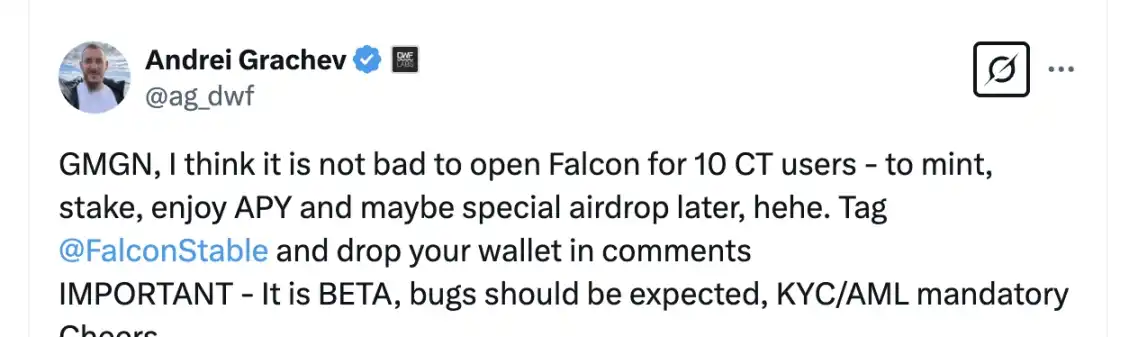
A synthetic USD stablecoin protocol launched by DWF Labs partner Andrei Grachev, currently in the alpha testing phase. Participation requires application (follow their X account for periodic chances to qualify for alpha testing, early depositors enjoy high APY and potential airdrops). For more details, refer to "With an Annualized Yield of 22.6%, How Does Falcon Finance—Backed by DWF Partners—Achieve High Returns."
Reasons to Follow: TVL has exceeded $90 million ($92.1 million), and Andrei Grachev has hinted at possible future airdrops.
Recent Financing News
1. Mesh ($82 million)
Project Overview: Mesh is a company focused on crypto payments. For more details, refer to "With a Total Funding of $104 Million, Mesh Launches Crypto Payment 'New Infrastructure' Battle."
Reasons to Follow: Amid RWAfi's backdrop: high funding, participation of heavyweight investment institutions, and deep collaboration with PayPal's PYUSD.
2. RedotPay ($40 million)
Project Overview: RedotPay is also a project focused on cryptocurrency payments built by a Hong Kong team. It offers virtual and physical cards, supports ATMs, and accepts payments through QR codes, phone numbers, and RedotPay IDs. The project is backed by a Hong Kong-licensed trust and corporate services provider.
Reasons to Watch: Supported by Sequoia China and Lightspeed Venture Partners, strong focus on security and compliance, and provides fast and seamless payment experience. Launched the RedotPay Alliance Program, where members can enjoy a 40% transaction commission (calculated every 30 days).
3. Rain ($24.5 Million, Card-Issuing Business)
Project Overview:
Rain is a stablecoin-supported enterprise card issuer that offers custom debit, credit, and prepaid cards for businesses to issue B2B and consumer cards. These cards are directly linked to self-custody wallets, custodial solutions, or traditional fiat accounts. Cardholders can make payments without converting their cryptocurrency to government-issued currency. Rain has built stablecoin interoperability infrastructure across fiat currencies, supporting native settlements on multiple blockchain networks (such as Base, Polygon, Optimism, Avalanche, Arbitrum, ZKsync, and Solana) with transactions settled in stablecoins, currently covering over 100 countries globally.
Reasons to Watch: Led by Norwest Venture Partners, with participation from Lightspeed Venture Partners, Coinbase Ventures, among others. Sponsored and operated by Visa as a key member of the card project.
4. Yeet (Raised $7.75 Million Last Year, Announcement This Year)
Project Overview:
A crypto gaming platform led by Dragonfly with investments from Primitive Ventures and Mirana Ventures, supported by investors like the CEO of LayerZero and the CEO of Fat Penguin. A "crypto casino" founded by well-known figures in the crypto space, Michael Anderson (alias Mando), the anonymous trader Keyboard Monkey, and professional poker player Ben Lamb. Currently in the testing phase, users can join a waiting list. The known information includes the launch of several games in its beta version and the project's referral program, where users can not only profit directly from referrals but also earn from the referrals of those referred by their referrals, with a maximum of 3 levels of referral rewards.
Reasons for Attention: Dragonfly led the investment, the founder's professional background, and a significant 3-tiered referral reward.
5. Opinion Labs ($5 million)
Project Overview:
Opinion Labs is a prediction market platform with YZi Labs as the lead investor, also one of the top 4 performing projects in its MVB program. It has currently launched its Beta version, supporting the Monad testnet and Base network. Users can now register an account to receive USDO test tokens for trading operations, complete social tasks, or invite friends to earn points. Here is a referral code for registration: dfRAhCsx.

Reasons for Attention: YZi Labs led the investment, the Monad testnet is easy to use, there is an expectation of a token-based system or airdrop, and it can serve as an interactive project with no initial investment required.
Above are the new projects recommended this time. If you are interested, you can spend some time to continue monitoring or apply for early participation. Before the market heats up, the editor will continue to recommend new projects to everyone, hoping to earn additional profits in the future.
You may also like

$75 billion in foreign capital has fled, and South Korean retail investors have absorbed it all using leverage

Bitcoin Trading Guide 2026: Strategies for Experienced Traders

What Is XAUT and PAXG? Why Tokenized Gold Is Booming in 2026

Cryptocurrency CEXs are flocking to sell US stocks, and traditional brokerages are facing an "uninvited guest."

Will the SpaceX IPO Hurt Bitcoin? Here's What Traders Are Watching
Foreign selling in the South Korean stock market accelerates, with cumulative net sales reportedly reaching $75 billion this year
On June 9, The Kobeissi Letter, citing Goldman Sachs data, reported that global investors are selling South Korean stocks at an unusually rapid pace. In the latest trading session, foreign investors sold about $801 million worth of Kospi constituent stocks again; total foreign outflows last week reached about $10 billion, and the market has been in net foreign selling on nearly every trading day over the past month. According to the data cited in the report, foreign investors have sold about $75 billion worth of South Korean stocks so far this year. Meanwhile, South Korean retail and institutional investors together recorded roughly $69 billion in net buying over the same period, suggesting that the market’s main buying support has come from domestic capital rather than returning overseas funds. The information currently disclosed still mainly comes from The Kobeissi Letter’s retelling and Goldman Sachs data summaries, while public details on the statistical period and the specific definition of “selling” remain relatively limited.

Fortune Warns of Strategy’s Financing Structure Risks as Bitcoin Premium Narrows
Fortune warned that Strategy’s Bitcoin treasury model faces growing financing risks as MSTR’s net asset premium narrows and preferred stock dividend pressure increases.

Ferrari Challenge Le Mans: Carl Moon to Dominate in WEEX Livery

Sahara AI Responds to SAHARA’s Sharp Drop: No Contract or Product Security Issues Found, Internal Investigation Underway
Sahara AI responded to SAHARA’s 60% price drop, saying no token contract or product security issues have been found and an internal investigation is underway.

WEEX Deposit/Withdrawal Dynamic Island: Your Asset Status, Always in Sight

Scaling Crypto Derivatives: The Digital Asset Infrastructure Behind High-Volume Trading
In the fast-moving digital asset ecosystem, derivatives platforms face an extreme architectural test. High-leverage futures markets demand more than just standard security—they require absolute operational precision, zero-latency matching engines, and ironclad structural scalability, all while navigating intense market volatility.
As global platforms scale to meet these demands, the industry is shifting away from rigid, monolithic setups toward a more agile, "decoupled" infrastructure philosophy.
The Blueprint for High-Volume Copy TradingFor elite global exchanges like WEEX (founded in 2018), this architectural choice becomes critical when scaling high-volume retail features like social copy trading. When thousands of users automatically mirror the real-time strategies of elite traders simultaneously, it triggers sudden, monumental spikes in concurrent transactional volume.
To prevent execution latency or settlement bottlenecks during these peak volatility events, a platform's primary engine must remain entirely dedicated to risk management, copy-trade synchronization, and order matching.
The Architectural Rule: New-generation platforms must separate front-end user execution engines from heavy backend infrastructural overhead to eliminate operational friction.
By separating these layers, platforms can maintain complete sovereignty over their trading environments and user experiences while strategically aligning with institutional-grade infrastructure ecosystems. This strategic framework allows modern exchanges to leverage advanced Digital Asset Custody infrastructure such as Cobo’s behind the scenes, ensuring that backend wallet management scales elastically alongside trading spikes.
Capitalizing on Market Momentum and 400× LeverageIn a derivatives arena where platforms offer up to 400× leverage on perpetual contracts, capital efficiency and market agility are core business metrics. To capture market momentum, an exchange needs the ability to rapidly expand its asset offerings, supporting everything from legacy crypto assets to sudden, trending altcoins across a massive library of trading pairs.
Adopting a flexible, scalable Wallet-as-a-Service (WaaS) solution such as Cobo’s could completely rewrite the development timeline for high-growth exchanges. Instead of spending months of engineering capital building out custom backend wallet architectures for every new blockchain network, platforms can deploy localized infrastructure in days.
This agility allows platforms to instantly scale their listings to over a thousand trading pairs without compromising security or delaying time-to-market. It mirrors the exact operational advantages seen during high-velocity market events, similar to how advanced wallet infrastructure empowers platforms during sudden asset surges; allowing exchanges to pass that speed and liquidity directly to their global user base.
A Mature Foundation for GrowthThe synergy between trusted infrastructure ecosystems and global trading platforms represents the natural evolution of a maturing crypto market. As WEEX continues to scale its global spot and derivatives offerings for over 6 million users, adopting robust backend paradigms proves that platforms no longer have to compromise between cutting-edge trading velocity and uncompromised structural security.

Morning Report | BitMine increased its holdings by 126,971 ETH last week; trader Eugene announced his exit from the crypto market

Wang Chuan: How can one not feel anxious after the neighbor Old Wang made thirty times profit by investing in storage stocks? (Seven) - A quarter-century cycle

Get Paid to Onboard? Try WEEX’s New Homepage with Rewards for Registration, Deposit & Trade

WEEX Custom Layout: Build Your Perfect Trading Workspace in Seconds

See “Buy Walls” & “Sell Walls” Instantly: WEEX Launches the Depth Chart for Smarter Trades

What Is Quick Trade on WEEX? 2 Ways WEEX Ends Chart-Panel Jumping
Morning News | Five major virtual asset platforms in South Korea have experienced 57 incidents of hacking and system failures in six years; Grayscale submits registration application for Canton ETF
$75 billion in foreign capital has fled, and South Korean retail investors have absorbed it all using leverage
Bitcoin Trading Guide 2026: Strategies for Experienced Traders
What Is XAUT and PAXG? Why Tokenized Gold Is Booming in 2026
Cryptocurrency CEXs are flocking to sell US stocks, and traditional brokerages are facing an "uninvited guest."
Will the SpaceX IPO Hurt Bitcoin? Here's What Traders Are Watching
Foreign selling in the South Korean stock market accelerates, with cumulative net sales reportedly reaching $75 billion this year
On June 9, The Kobeissi Letter, citing Goldman Sachs data, reported that global investors are selling South Korean stocks at an unusually rapid pace. In the latest trading session, foreign investors sold about $801 million worth of Kospi constituent stocks again; total foreign outflows last week reached about $10 billion, and the market has been in net foreign selling on nearly every trading day over the past month. According to the data cited in the report, foreign investors have sold about $75 billion worth of South Korean stocks so far this year. Meanwhile, South Korean retail and institutional investors together recorded roughly $69 billion in net buying over the same period, suggesting that the market’s main buying support has come from domestic capital rather than returning overseas funds. The information currently disclosed still mainly comes from The Kobeissi Letter’s retelling and Goldman Sachs data summaries, while public details on the statistical period and the specific definition of “selling” remain relatively limited.


