
SEC Announces "PoW Mining Does Not Constitute Securities Issuance" Action, Miners Welcome Regulatory Spring

Original Article Title: "SEC Announces 'PoW Mining Not Considered Securities,' Miners Do Not Need to Register, Welcoming a Major Regulatory Victory"
Original Article Author: Natalia Wu, BlockTempo
The U.S. Securities and Exchange Commission (SEC) announced regulatory guidance on Proof of Work (PoW) mining activities on the 20th, and for the first time concluded that "PoW mining activities do not constitute a securities offering," thus exempting them from federal securities law regulation, and mining participants do not need to register with the SEC.
This decision provides clear regulatory clarity for PoW miners and mining pools, alleviating their concerns about compliance with U.S. securities laws.
SEC Confirms PoW Mining Exempt from Securities Law Regulation
The SEC views PoW mining as an "administrative or transactional activity" rather than an investment contract. Miners validate transactions and secure the blockchain network by providing computational resources, earning newly minted cryptocurrency (referred to as "Covered Crypto Assets") as a reward. This process does not rely on third-party management or entrepreneurial efforts, which is a key criterion in the Howey test (used to determine whether an asset is a security).
The SEC considers "protocol mining" as the process of validating transactions and maintaining network security on a PoW blockchain. These networks are decentralized, permissionless systems, and miners add new blocks to the blockchain by solving complex cryptographic puzzles. Miners can participate without owning the network's native cryptocurrency, further distinguishing mining from securities issuance.
The SEC stated that its declaration covers only "protocol mining" activities involving:
• Miners mining cryptographic assets on a PoW network: The SEC emphasizes that these rewards come from the miners' own efforts, not third-party management, making them administrative tasks rather than securities transactions.
• The roles of mining pools and pool operators participating in the protocol mining process, including their roles in earning and distributing rewards. The SEC believes that miners' earnings in the pool are related to their computational contributions, not the pool operator's efforts, so these activities are also exempt from securities law regulation.
Cryptocurrency Mining Industry Regulatory Victory
This clarification is a significant victory for the PoW mining community. The SEC's confirmation that mining is not subject to securities regulation means that miners and pool operators can continue their operations without registering or complying with additional legal requirements. This decision may enhance confidence in the mining industry, especially in the context of ongoing regulatory scrutiny of mining due to energy consumption and environmental impact concerns.
It is worth noting that, after the Trump administration, the SEC has ushered in a crypto-friendly new leadership team and has been committed to providing a clearer regulatory stance. The SEC first defined the classification of digital assets at the end of February, categorizing Bitcoin as a digital commodity and determining that meme coins are not securities, with investors bearing the risk.
PoW Coins Experience Overall Decline in the Past 24 Hours
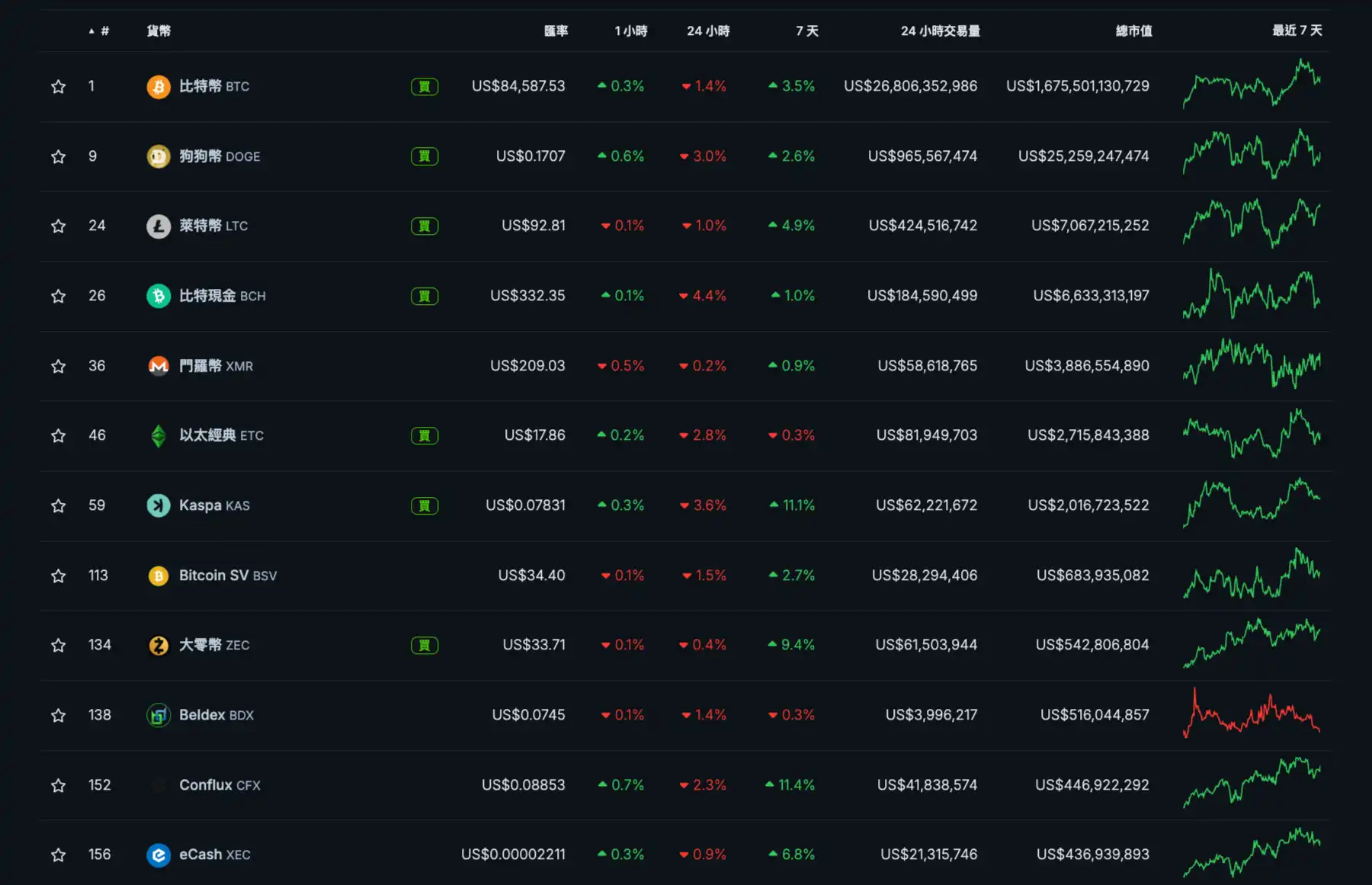
However, following the SEC's announcement, the prices of PoW tokens did not show a significant increase. In the past 24 hours, they followed the overall cryptocurrency market trend and experienced a general decline.
Due to the lack of highlights and substantial positive news in Trump's speech at the digital asset summit, as well as the escalating tariff war raising risk aversion sentiment, Bitcoin plummeted from $86,529 last night to a low of $83,642, a 3.3% drop, and has since slightly rebounded to $84,528, representing a 1.5% decline in the past 24 hours.
You may also like

WEEX Deposit/Withdrawal Dynamic Island: Your Asset Status, Always in Sight

Scaling Crypto Derivatives: The Digital Asset Infrastructure Behind High-Volume Trading
In the fast-moving digital asset ecosystem, derivatives platforms face an extreme architectural test. High-leverage futures markets demand more than just standard security—they require absolute operational precision, zero-latency matching engines, and ironclad structural scalability, all while navigating intense market volatility.
As global platforms scale to meet these demands, the industry is shifting away from rigid, monolithic setups toward a more agile, "decoupled" infrastructure philosophy.
The Blueprint for High-Volume Copy TradingFor elite global exchanges like WEEX (founded in 2018), this architectural choice becomes critical when scaling high-volume retail features like social copy trading. When thousands of users automatically mirror the real-time strategies of elite traders simultaneously, it triggers sudden, monumental spikes in concurrent transactional volume.
To prevent execution latency or settlement bottlenecks during these peak volatility events, a platform's primary engine must remain entirely dedicated to risk management, copy-trade synchronization, and order matching.
The Architectural Rule: New-generation platforms must separate front-end user execution engines from heavy backend infrastructural overhead to eliminate operational friction.
By separating these layers, platforms can maintain complete sovereignty over their trading environments and user experiences while strategically aligning with institutional-grade infrastructure ecosystems. This strategic framework allows modern exchanges to leverage advanced Digital Asset Custody infrastructure such as Cobo’s behind the scenes, ensuring that backend wallet management scales elastically alongside trading spikes.
Capitalizing on Market Momentum and 400× LeverageIn a derivatives arena where platforms offer up to 400× leverage on perpetual contracts, capital efficiency and market agility are core business metrics. To capture market momentum, an exchange needs the ability to rapidly expand its asset offerings, supporting everything from legacy crypto assets to sudden, trending altcoins across a massive library of trading pairs.
Adopting a flexible, scalable Wallet-as-a-Service (WaaS) solution such as Cobo’s could completely rewrite the development timeline for high-growth exchanges. Instead of spending months of engineering capital building out custom backend wallet architectures for every new blockchain network, platforms can deploy localized infrastructure in days.
This agility allows platforms to instantly scale their listings to over a thousand trading pairs without compromising security or delaying time-to-market. It mirrors the exact operational advantages seen during high-velocity market events, similar to how advanced wallet infrastructure empowers platforms during sudden asset surges; allowing exchanges to pass that speed and liquidity directly to their global user base.
A Mature Foundation for GrowthThe synergy between trusted infrastructure ecosystems and global trading platforms represents the natural evolution of a maturing crypto market. As WEEX continues to scale its global spot and derivatives offerings for over 6 million users, adopting robust backend paradigms proves that platforms no longer have to compromise between cutting-edge trading velocity and uncompromised structural security.

Morning Report | BitMine increased its holdings by 126,971 ETH last week; trader Eugene announced his exit from the crypto market

Wang Chuan: How can one not feel anxious after the neighbor Old Wang made thirty times profit by investing in storage stocks? (Seven) - A quarter-century cycle

Get Paid to Onboard? Try WEEX’s New Homepage with Rewards for Registration, Deposit & Trade

WEEX Custom Layout: Build Your Perfect Trading Workspace in Seconds

See “Buy Walls” & “Sell Walls” Instantly: WEEX Launches the Depth Chart for Smarter Trades

What Is Quick Trade on WEEX? 2 Ways WEEX Ends Chart-Panel Jumping
Morning News | Five major virtual asset platforms in South Korea have experienced 57 incidents of hacking and system failures in six years; Grayscale submits registration application for Canton ETF

Should we escape the peak? The principle of the tail-end market in the stock market

RootData: May 2026 Cryptocurrency Exchange Transparency Research Report

Founder of Baixing.com: My Experience with Claude Code in Fourteen Points

Yang Ge Gary: Agent Economics and AI Microeconomics
When reasoning becomes a scarce resource, who captures its value?

Jensen Huang dramatically "rescues" the South Korean stock market

Stablecoins vs Deposit Tokens: On the surface, they seem like opposing sides, but in reality, they are interconnected

Bitcoin Crash to $50,000 or Bear Trap Before $100,000? Deep Dive for WEEX Traders
How Could the SpaceX IPO Affect Bitcoin, Altcoins season, and Crypto Liquidity?
WEEX Deposit/Withdrawal Dynamic Island: Your Asset Status, Always in Sight
Scaling Crypto Derivatives: The Digital Asset Infrastructure Behind High-Volume Trading
In the fast-moving digital asset ecosystem, derivatives platforms face an extreme architectural test. High-leverage futures markets demand more than just standard security—they require absolute operational precision, zero-latency matching engines, and ironclad structural scalability, all while navigating intense market volatility.
As global platforms scale to meet these demands, the industry is shifting away from rigid, monolithic setups toward a more agile, "decoupled" infrastructure philosophy.
The Blueprint for High-Volume Copy TradingFor elite global exchanges like WEEX (founded in 2018), this architectural choice becomes critical when scaling high-volume retail features like social copy trading. When thousands of users automatically mirror the real-time strategies of elite traders simultaneously, it triggers sudden, monumental spikes in concurrent transactional volume.
To prevent execution latency or settlement bottlenecks during these peak volatility events, a platform's primary engine must remain entirely dedicated to risk management, copy-trade synchronization, and order matching.
The Architectural Rule: New-generation platforms must separate front-end user execution engines from heavy backend infrastructural overhead to eliminate operational friction.
By separating these layers, platforms can maintain complete sovereignty over their trading environments and user experiences while strategically aligning with institutional-grade infrastructure ecosystems. This strategic framework allows modern exchanges to leverage advanced Digital Asset Custody infrastructure such as Cobo’s behind the scenes, ensuring that backend wallet management scales elastically alongside trading spikes.
Capitalizing on Market Momentum and 400× LeverageIn a derivatives arena where platforms offer up to 400× leverage on perpetual contracts, capital efficiency and market agility are core business metrics. To capture market momentum, an exchange needs the ability to rapidly expand its asset offerings, supporting everything from legacy crypto assets to sudden, trending altcoins across a massive library of trading pairs.
Adopting a flexible, scalable Wallet-as-a-Service (WaaS) solution such as Cobo’s could completely rewrite the development timeline for high-growth exchanges. Instead of spending months of engineering capital building out custom backend wallet architectures for every new blockchain network, platforms can deploy localized infrastructure in days.
This agility allows platforms to instantly scale their listings to over a thousand trading pairs without compromising security or delaying time-to-market. It mirrors the exact operational advantages seen during high-velocity market events, similar to how advanced wallet infrastructure empowers platforms during sudden asset surges; allowing exchanges to pass that speed and liquidity directly to their global user base.
A Mature Foundation for GrowthThe synergy between trusted infrastructure ecosystems and global trading platforms represents the natural evolution of a maturing crypto market. As WEEX continues to scale its global spot and derivatives offerings for over 6 million users, adopting robust backend paradigms proves that platforms no longer have to compromise between cutting-edge trading velocity and uncompromised structural security.
Morning Report | BitMine increased its holdings by 126,971 ETH last week; trader Eugene announced his exit from the crypto market
Wang Chuan: How can one not feel anxious after the neighbor Old Wang made thirty times profit by investing in storage stocks? (Seven) - A quarter-century cycle
Get Paid to Onboard? Try WEEX’s New Homepage with Rewards for Registration, Deposit & Trade
WEEX Custom Layout: Build Your Perfect Trading Workspace in Seconds


