
Stablecoin Market Dynamics Shift: USDC Dominance Doubles, Rising Star USDe Emerges

Original Article Title: "The State of Stablecoins 2025: Supply, Adoption & Market Trends"
Original Article Author: Artemis, Dune
Original Article Translation: Yuliya, PANews
Stablecoins are reshaping the global financial system at an unprecedented pace. According to the joint report "Stablecoin State in 2025" released by Dune and Artemis, the stablecoin market has experienced significant growth in the past year, institutional adoption has accelerated, decentralized stablecoins have emerged, and on-chain transaction activity continues to rise.
Market Size and Growth Trends
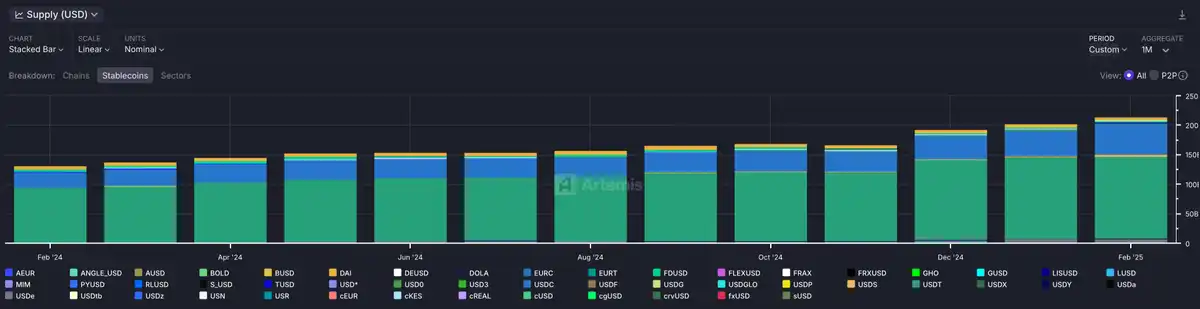
As of February 2025, the supply of stablecoins has reached $2.14 trillion, with an annual transaction volume of $35 trillion, doubling the size of Visa's annual transaction volume. Market activity is on the rise, with a 53% increase in on-chain active addresses, surpassing 30 million. Institutional funds are flowing in on a large scale, driving deep integration between Traditional Finance (TradFi) and the crypto market.
Shift in USDC and USDT Dominance
Driven by the compliance process and market strategies, USDC and USDT still dominate the market, but there have been subtle shifts in market share.
USDC's market capitalization has doubled to $560 billion, mainly due to regulatory approvals under MiCA and DIFC, the participation of key strategic partners such as Stripe and MoneyGram, and rapid global market expansion.
USDT's total market capitalization has grown to $1.46 trillion, remaining the largest stablecoin by market capitalization, but its market share has declined. Institutional adoption is decreasing, and the focus is gradually shifting to the P2P remittance market, consolidating its position in the global payment sector.

Rise of Decentralized Stablecoins
In the Decentralized Finance (DeFi) ecosystem, the influence of decentralized stablecoins has significantly increased, with several emerging projects achieving breakthrough growth.
· USDe (Ethena Labs): Its market value surged from $1.46 billion to $62 billion, becoming the third-largest stablecoin in the market. The key to its growth lies in its innovative yield strategy and Delta-neutral hedging mechanism.
· USDS (MakerDAO): MakerDAO has rebranded as Sky and launched the compliance-friendly USDS, with a market capitalization reaching $2.6 billion in February 2025. This adjustment has enhanced its competitiveness in the decentralized stablecoin market.

Fund Flows and Industry Distribution
The flow of stablecoins reflects the positioning and competitiveness of different blockchains in the market:
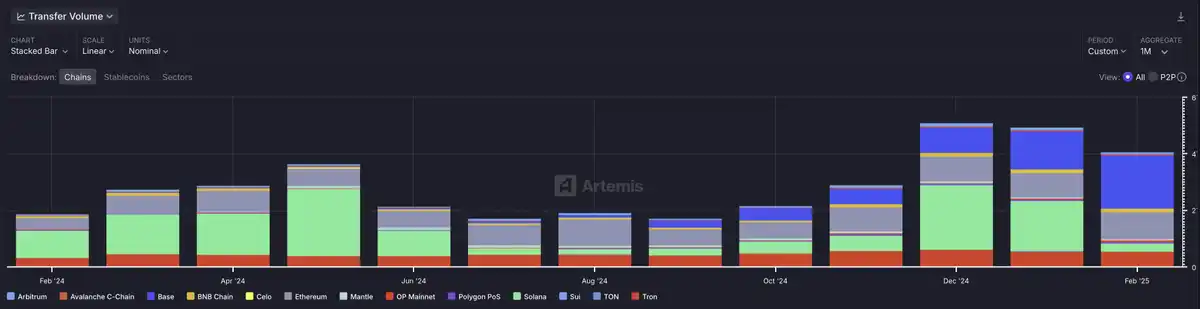
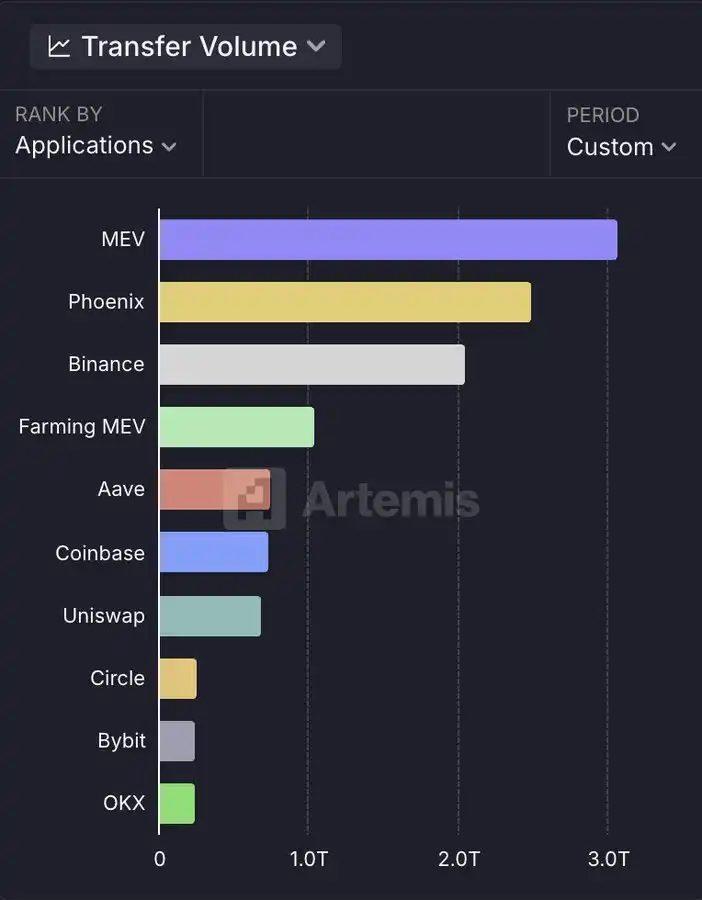
Ethereum remains the primary issuance platform for stablecoins, holding a 55% supply share. Base and Solana have seen rapid growth in transaction volume, driven by the DeFi and Meme coin markets, becoming key on-chain ecosystems for stablecoin circulation. TRON continues to hold a core position in the global P2P payment and cross-border remittance markets, especially in emerging markets, where stablecoins are widely used for payments and savings.
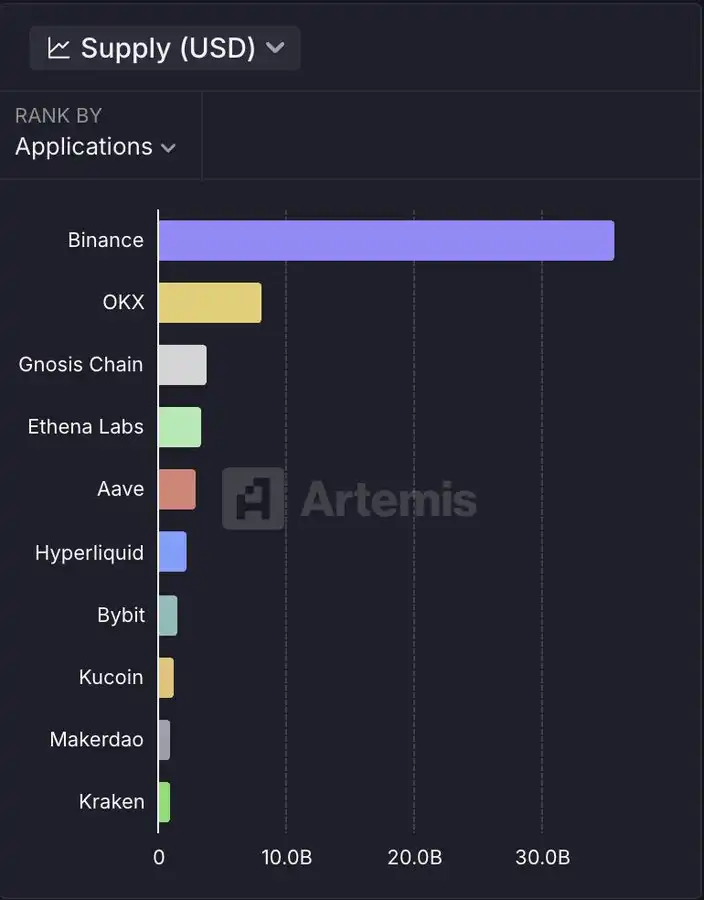
Most stablecoin liquidity is concentrated on centralized exchanges (CEX), with transaction volumes mainly driven by DeFi (DEX, lending, yield farming), reflecting efficient capital flow and innovation.
Core Functions and Future Development
Stablecoins have become a critical infrastructure in the crypto market and are also driving innovation in the traditional financial sector. Industry experts are optimistic about the future development of stablecoins:
"Stablecoins are the lifeline of the crypto market and the superconductor of the financial system. They have opened up new markets and financial opportunities, driving innovation that was previously out of reach." — Rob Hadick, General Partner at Dragonfly
"Stablecoins have significant advantages in cross-border payments. We hope Base will support more local currency stablecoins, allowing global users to transact on-chain with their familiar currencies, thus increasing the adoption of blockchain technology." — Neodaoist, Product Lead at Base
"The next generation of stablecoins must have market resilience. The core of USDe is a yield-backed stability mechanism, ensuring users have a reliable USD alternative." — Conor Ryder, Head of Research at Ethena Labs
"The flow of stablecoins depends on the quality of infrastructure — low cost, fast transactions, and market demand. On Solana, the liquidity for Meme coin trading pairs and instant settlement is high, making stablecoins an indispensable part." — Andrew Hong, Founder and Data Analytics Expert at Herd
「TRON has become the preferred blockchain for stablecoin transactions, with daily trading volumes reaching billions of dollars. USDT on TRON has driven real economic activities, especially in emerging markets, and has become a key tool for payments and savings.」 ——TRON DAO Community Spokesperson Sam Elfarra
You may also like

WEEX Deposit/Withdrawal Dynamic Island: Your Asset Status, Always in Sight

Scaling Crypto Derivatives: The Digital Asset Infrastructure Behind High-Volume Trading
In the fast-moving digital asset ecosystem, derivatives platforms face an extreme architectural test. High-leverage futures markets demand more than just standard security—they require absolute operational precision, zero-latency matching engines, and ironclad structural scalability, all while navigating intense market volatility.
As global platforms scale to meet these demands, the industry is shifting away from rigid, monolithic setups toward a more agile, "decoupled" infrastructure philosophy.
The Blueprint for High-Volume Copy TradingFor elite global exchanges like WEEX (founded in 2018), this architectural choice becomes critical when scaling high-volume retail features like social copy trading. When thousands of users automatically mirror the real-time strategies of elite traders simultaneously, it triggers sudden, monumental spikes in concurrent transactional volume.
To prevent execution latency or settlement bottlenecks during these peak volatility events, a platform's primary engine must remain entirely dedicated to risk management, copy-trade synchronization, and order matching.
The Architectural Rule: New-generation platforms must separate front-end user execution engines from heavy backend infrastructural overhead to eliminate operational friction.
By separating these layers, platforms can maintain complete sovereignty over their trading environments and user experiences while strategically aligning with institutional-grade infrastructure ecosystems. This strategic framework allows modern exchanges to leverage advanced Digital Asset Custody infrastructure such as Cobo’s behind the scenes, ensuring that backend wallet management scales elastically alongside trading spikes.
Capitalizing on Market Momentum and 400× LeverageIn a derivatives arena where platforms offer up to 400× leverage on perpetual contracts, capital efficiency and market agility are core business metrics. To capture market momentum, an exchange needs the ability to rapidly expand its asset offerings, supporting everything from legacy crypto assets to sudden, trending altcoins across a massive library of trading pairs.
Adopting a flexible, scalable Wallet-as-a-Service (WaaS) solution such as Cobo’s could completely rewrite the development timeline for high-growth exchanges. Instead of spending months of engineering capital building out custom backend wallet architectures for every new blockchain network, platforms can deploy localized infrastructure in days.
This agility allows platforms to instantly scale their listings to over a thousand trading pairs without compromising security or delaying time-to-market. It mirrors the exact operational advantages seen during high-velocity market events, similar to how advanced wallet infrastructure empowers platforms during sudden asset surges; allowing exchanges to pass that speed and liquidity directly to their global user base.
A Mature Foundation for GrowthThe synergy between trusted infrastructure ecosystems and global trading platforms represents the natural evolution of a maturing crypto market. As WEEX continues to scale its global spot and derivatives offerings for over 6 million users, adopting robust backend paradigms proves that platforms no longer have to compromise between cutting-edge trading velocity and uncompromised structural security.

Morning Report | BitMine increased its holdings by 126,971 ETH last week; trader Eugene announced his exit from the crypto market

Wang Chuan: How can one not feel anxious after the neighbor Old Wang made thirty times profit by investing in storage stocks? (Seven) - A quarter-century cycle

Get Paid to Onboard? Try WEEX’s New Homepage with Rewards for Registration, Deposit & Trade

WEEX Custom Layout: Build Your Perfect Trading Workspace in Seconds

See “Buy Walls” & “Sell Walls” Instantly: WEEX Launches the Depth Chart for Smarter Trades

What Is Quick Trade on WEEX? 2 Ways WEEX Ends Chart-Panel Jumping
Morning News | Five major virtual asset platforms in South Korea have experienced 57 incidents of hacking and system failures in six years; Grayscale submits registration application for Canton ETF

Should we escape the peak? The principle of the tail-end market in the stock market

RootData: May 2026 Cryptocurrency Exchange Transparency Research Report

Founder of Baixing.com: My Experience with Claude Code in Fourteen Points

Yang Ge Gary: Agent Economics and AI Microeconomics
When reasoning becomes a scarce resource, who captures its value?

Jensen Huang dramatically "rescues" the South Korean stock market

Stablecoins vs Deposit Tokens: On the surface, they seem like opposing sides, but in reality, they are interconnected

Bitcoin Crash to $50,000 or Bear Trap Before $100,000? Deep Dive for WEEX Traders
How Could the SpaceX IPO Affect Bitcoin, Altcoins season, and Crypto Liquidity?
WEEX Deposit/Withdrawal Dynamic Island: Your Asset Status, Always in Sight
Scaling Crypto Derivatives: The Digital Asset Infrastructure Behind High-Volume Trading
In the fast-moving digital asset ecosystem, derivatives platforms face an extreme architectural test. High-leverage futures markets demand more than just standard security—they require absolute operational precision, zero-latency matching engines, and ironclad structural scalability, all while navigating intense market volatility.
As global platforms scale to meet these demands, the industry is shifting away from rigid, monolithic setups toward a more agile, "decoupled" infrastructure philosophy.
The Blueprint for High-Volume Copy TradingFor elite global exchanges like WEEX (founded in 2018), this architectural choice becomes critical when scaling high-volume retail features like social copy trading. When thousands of users automatically mirror the real-time strategies of elite traders simultaneously, it triggers sudden, monumental spikes in concurrent transactional volume.
To prevent execution latency or settlement bottlenecks during these peak volatility events, a platform's primary engine must remain entirely dedicated to risk management, copy-trade synchronization, and order matching.
The Architectural Rule: New-generation platforms must separate front-end user execution engines from heavy backend infrastructural overhead to eliminate operational friction.
By separating these layers, platforms can maintain complete sovereignty over their trading environments and user experiences while strategically aligning with institutional-grade infrastructure ecosystems. This strategic framework allows modern exchanges to leverage advanced Digital Asset Custody infrastructure such as Cobo’s behind the scenes, ensuring that backend wallet management scales elastically alongside trading spikes.
Capitalizing on Market Momentum and 400× LeverageIn a derivatives arena where platforms offer up to 400× leverage on perpetual contracts, capital efficiency and market agility are core business metrics. To capture market momentum, an exchange needs the ability to rapidly expand its asset offerings, supporting everything from legacy crypto assets to sudden, trending altcoins across a massive library of trading pairs.
Adopting a flexible, scalable Wallet-as-a-Service (WaaS) solution such as Cobo’s could completely rewrite the development timeline for high-growth exchanges. Instead of spending months of engineering capital building out custom backend wallet architectures for every new blockchain network, platforms can deploy localized infrastructure in days.
This agility allows platforms to instantly scale their listings to over a thousand trading pairs without compromising security or delaying time-to-market. It mirrors the exact operational advantages seen during high-velocity market events, similar to how advanced wallet infrastructure empowers platforms during sudden asset surges; allowing exchanges to pass that speed and liquidity directly to their global user base.
A Mature Foundation for GrowthThe synergy between trusted infrastructure ecosystems and global trading platforms represents the natural evolution of a maturing crypto market. As WEEX continues to scale its global spot and derivatives offerings for over 6 million users, adopting robust backend paradigms proves that platforms no longer have to compromise between cutting-edge trading velocity and uncompromised structural security.
Morning Report | BitMine increased its holdings by 126,971 ETH last week; trader Eugene announced his exit from the crypto market
Wang Chuan: How can one not feel anxious after the neighbor Old Wang made thirty times profit by investing in storage stocks? (Seven) - A quarter-century cycle
Get Paid to Onboard? Try WEEX’s New Homepage with Rewards for Registration, Deposit & Trade
WEEX Custom Layout: Build Your Perfect Trading Workspace in Seconds


