
The weekly popularity shows no signs of waning, is BSC Meme about to enter a new era this time?



Original Title: "With Unabated Heat for a Week, Is This BSC Meme Really Entering a New Era?"
Original Author: Golem, Odaily Planet Daily
Recently, a BNB on-chain meme coin named BUBB has seen increased attention within the community, as Binance founder CZ actively interacted with and followed it on X platform in the early hours of March 21. According to GMGN data, after CZ's interaction, BUBB's market cap rose from $2.5 million to $27 million, a more than 10x increase. The price has since reached another all-time high after a brief pullback, with the market cap peaking at $34 million.

BUBB is not a typical "ride CZ's coattails" meme; it is a hand-drawn art-style meme coin created by @vutnerable. The meme coin was launched on the Four.meme platform in the early hours of March 20 and had previously reached a market cap high of $6 million before CZ's interaction.
The current community consensus is that BUBB will become the flagship art-style meme coin on the BNB Chain, filling the gap in this meme subsector on the BNB Chain. Furthermore, the significance of BUBB's emergence is that it signals significant overseas meme players' and devs' interest in the BNB Chain. Previously, art-style meme coins were mostly issued on the Solana chain. This also signifies that BNB on-chain memes are entering a new era, where on-chain trends are no longer solely focused on CZ and CZ's influence, and more original, community-driven memes are on the rise.
Is This BSC Meme Really Different This Time?
This week, Mubarak surged due to CZ's wild mentions over the past weekend. On Monday, we expressed concerns about whether the "CZ-style Build" would continue to be effective for the BNB Chain, especially considering that from various on-chain data in February, the "CZ-style Build" did not keep players and funds consistently on the BNB Chain (related read: In the Winter of Meme, Can the CZ-style Build Revive the BNB Chain First?).
Data Perspective: Unwavering Heat for a Week
However, after a week of observation, unexpectedly, from a data perspective, the on-chain heat of the BNB Chain has not diminished this time. Although there hasn't been much change in TVL and on-chain activity, DEX trading volume and the data from the main meme issuance platform, Four.meme, have been quite impressive.
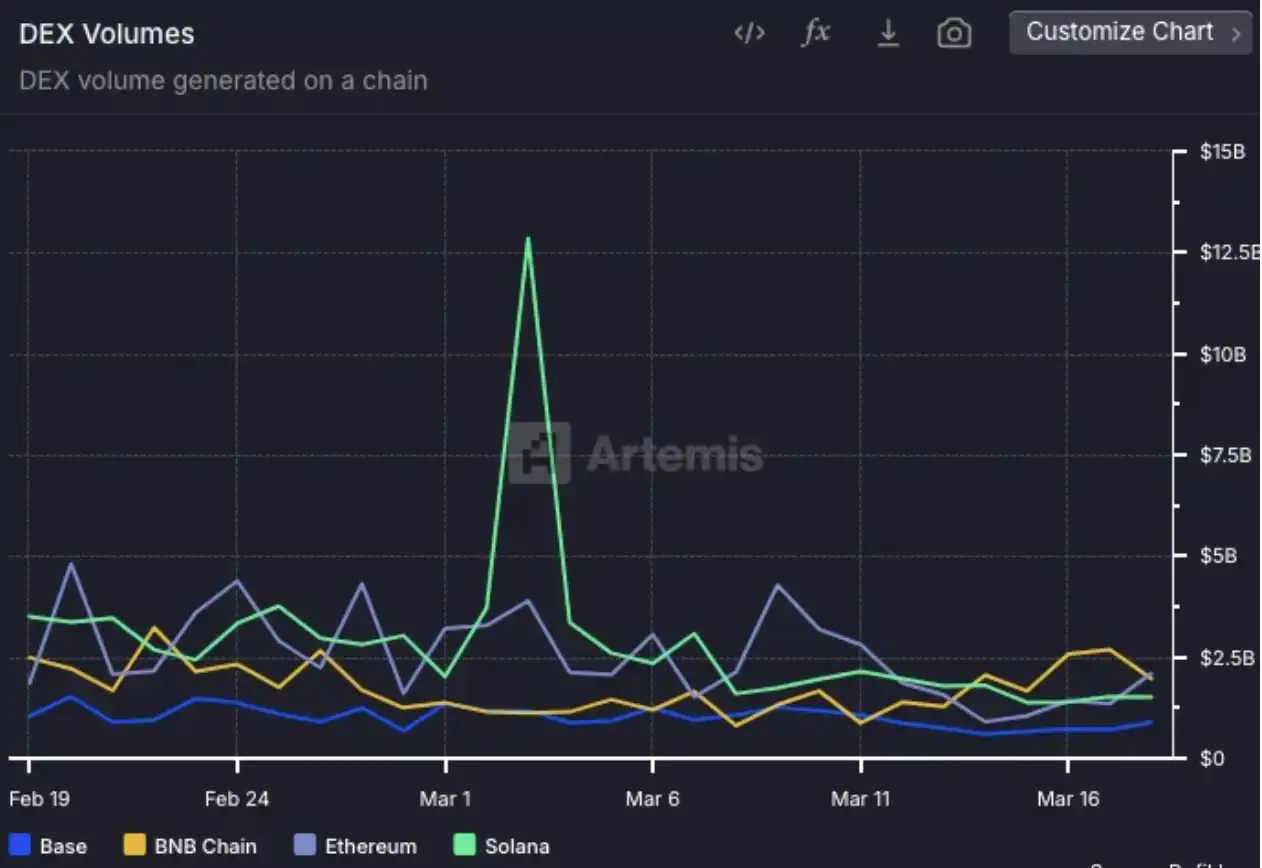
Starting with the DEX trading volume, Artemis data shows that from March 14th (early days of the Mubarak pump) to date, the BNB Chain DEX trading volume has consistently outperformed Solana, Ethereum, and Base on a daily basis.
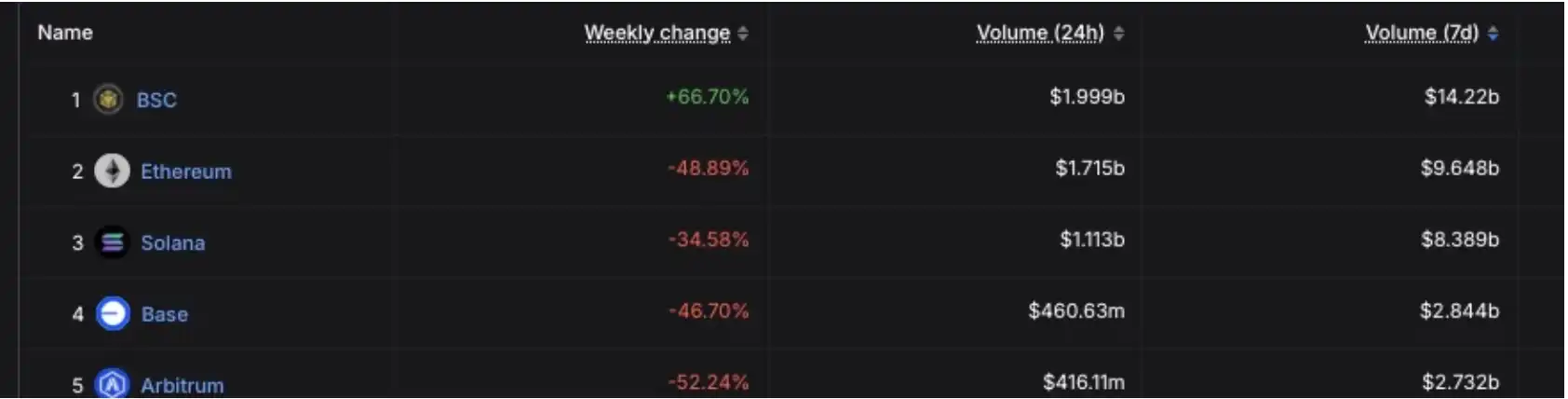
Additionally, according to DeFiLlama data, the BNB Chain DEX trading volume reached $14.22 billion in the past week, ranking first among blockchains, with Solana dropping to third place after Ethereum. The main DEX on the BNB Chain, PancakeSwap, also became the DEX with the highest trading volume in the past week.
Looking at Four.meme's data, according to Dune data, the Four.meme platform's total revenue currently exceeds 6266 BNB (approximately $4 million), increasing by about $1.5 million since the last record on March 17th. The platform's daily active users, daily token launches, and daily trading volume have also shown a growth trend over the past week.
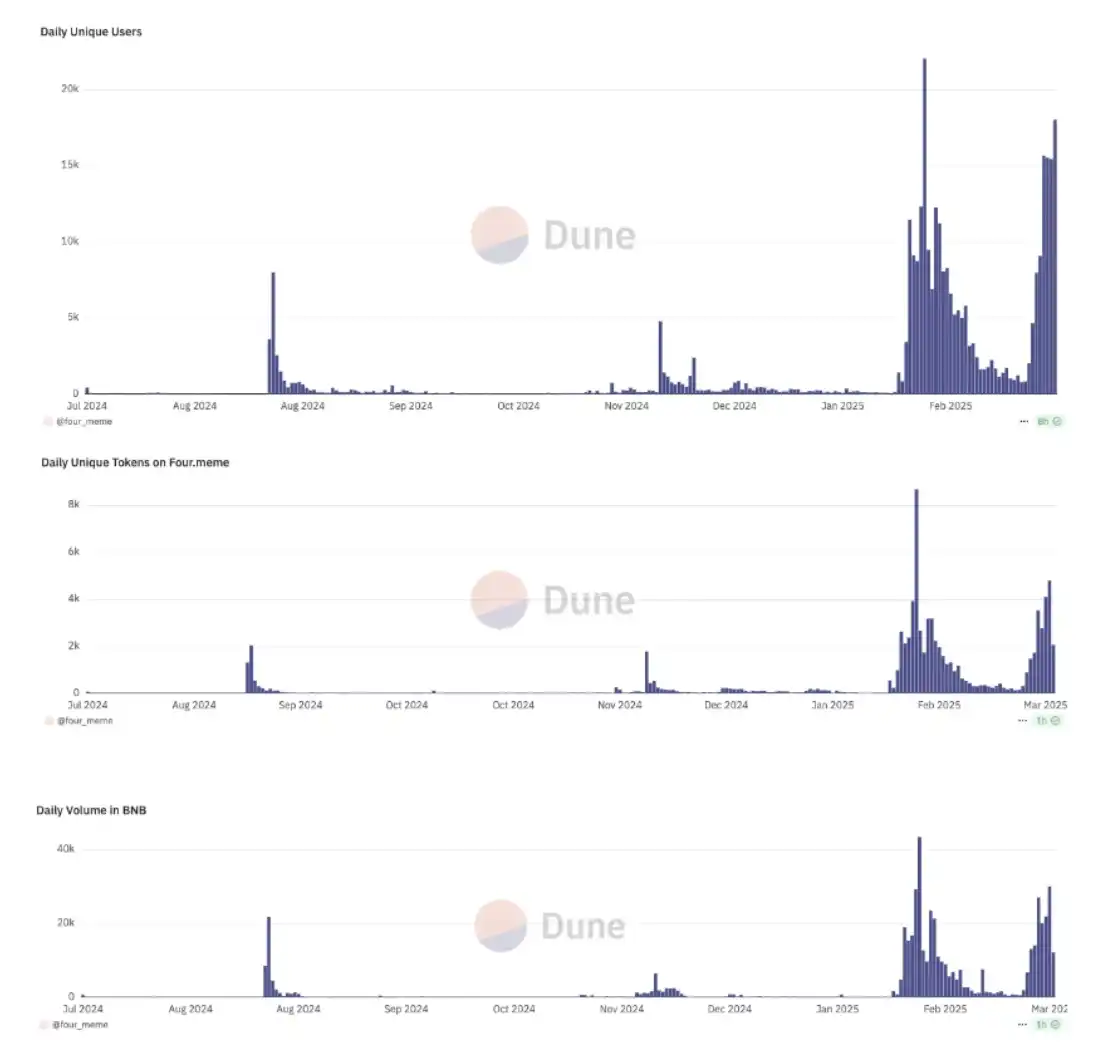
Combining the above data, the Meme craze on the BNB Chain this time shows stronger on-chain activity sustainability compared to the TST and CZ pet dog frenzy in February, with attention not fading away within a day or two. Of course, official support cannot be underestimated. This week, Binance co-founder He Yi significantly increased his activity on social media, actively engaging with the community and project teams. Today's BUBB pump is a vivid example of this.
Furthermore, Binance's first round of coin listing voting event launched on March 20th not only mobilized the enthusiasm of various Meme communities in the short term but also extended the expectation of BSC Meme listing on Binance spot market until March 27th. As long as the community sees hope, the heat of BNB Chain Memes will not diminish rapidly.
A New Narrative Emerges, No Longer Relying on He Yi and CZ
In addition to the impressive on-chain data, from a narrative perspective, the focus of this Meme craze is gradually shifting away from He Yi and CZ. In February, both TST and CZ's pet dog were on-chain trends strongly associated with CZ, and the same was observed during last weekend's Mubarak event. However, for a Meme ecosystem to develop healthily, it cannot solely rely on the founder's shilling but needs memes with higher community autonomy and better originality.
This week, the autonomy of BNB Chain meme is increasing. In addition to the hand-drawn art style meme coin BUBB mentioned at the beginning of the article, the zoo series on the BNB Chain is also rising. The meme coin ALANDALDS in this category is currently very popular, with a market value reaching around 1.2 million US dollars.
All these trends may indicate that this time, is the BSC meme really going to be different?
Wrapping Up
However, some people believe that these are just surface illusions. A week of positive on-chain data does not necessarily indicate anything, and meme coins like BUBB and ALANDALDS have not actually escaped the influence of He Yi and CZ; they are still in the spotlight because of this.
Essentially, memes on the BNB Chain are still divided into two categories: one is directly related to CZ or He Yi, with meme concepts actively promoted and mentioned by them, such as Broccoli, Mubarak, and others; the other is meme concepts that CZ and He Yi interact with or may be interested in, such as BUBB or AI.
Regardless, in the current environment of the overall downturn in the cryptocurrency market this week, memes on the BNB Chain and Binance's Wallet Genesis have become one of the few things that can excite players. Some are talking about getting rich overnight, while others are still watching from the sidelines. How long can this wave of BNB Chain memes last? What will happen next week? We continue to observe.
You may also like

Foreign selling in the South Korean stock market accelerates, with cumulative net sales reportedly reaching $75 billion this year
On June 9, The Kobeissi Letter, citing Goldman Sachs data, reported that global investors are selling South Korean stocks at an unusually rapid pace. In the latest trading session, foreign investors sold about $801 million worth of Kospi constituent stocks again; total foreign outflows last week reached about $10 billion, and the market has been in net foreign selling on nearly every trading day over the past month. According to the data cited in the report, foreign investors have sold about $75 billion worth of South Korean stocks so far this year. Meanwhile, South Korean retail and institutional investors together recorded roughly $69 billion in net buying over the same period, suggesting that the market’s main buying support has come from domestic capital rather than returning overseas funds. The information currently disclosed still mainly comes from The Kobeissi Letter’s retelling and Goldman Sachs data summaries, while public details on the statistical period and the specific definition of “selling” remain relatively limited.

Fortune Warns of Strategy’s Financing Structure Risks as Bitcoin Premium Narrows
Fortune warned that Strategy’s Bitcoin treasury model faces growing financing risks as MSTR’s net asset premium narrows and preferred stock dividend pressure increases.

Ferrari Challenge Le Mans: Carl Moon to Dominate in WEEX Livery

Sahara AI Responds to SAHARA’s Sharp Drop: No Contract or Product Security Issues Found, Internal Investigation Underway
Sahara AI responded to SAHARA’s 60% price drop, saying no token contract or product security issues have been found and an internal investigation is underway.

WEEX Deposit/Withdrawal Dynamic Island: Your Asset Status, Always in Sight

Scaling Crypto Derivatives: The Digital Asset Infrastructure Behind High-Volume Trading
In the fast-moving digital asset ecosystem, derivatives platforms face an extreme architectural test. High-leverage futures markets demand more than just standard security—they require absolute operational precision, zero-latency matching engines, and ironclad structural scalability, all while navigating intense market volatility.
As global platforms scale to meet these demands, the industry is shifting away from rigid, monolithic setups toward a more agile, "decoupled" infrastructure philosophy.
The Blueprint for High-Volume Copy TradingFor elite global exchanges like WEEX (founded in 2018), this architectural choice becomes critical when scaling high-volume retail features like social copy trading. When thousands of users automatically mirror the real-time strategies of elite traders simultaneously, it triggers sudden, monumental spikes in concurrent transactional volume.
To prevent execution latency or settlement bottlenecks during these peak volatility events, a platform's primary engine must remain entirely dedicated to risk management, copy-trade synchronization, and order matching.
The Architectural Rule: New-generation platforms must separate front-end user execution engines from heavy backend infrastructural overhead to eliminate operational friction.
By separating these layers, platforms can maintain complete sovereignty over their trading environments and user experiences while strategically aligning with institutional-grade infrastructure ecosystems. This strategic framework allows modern exchanges to leverage advanced Digital Asset Custody infrastructure such as Cobo’s behind the scenes, ensuring that backend wallet management scales elastically alongside trading spikes.
Capitalizing on Market Momentum and 400× LeverageIn a derivatives arena where platforms offer up to 400× leverage on perpetual contracts, capital efficiency and market agility are core business metrics. To capture market momentum, an exchange needs the ability to rapidly expand its asset offerings, supporting everything from legacy crypto assets to sudden, trending altcoins across a massive library of trading pairs.
Adopting a flexible, scalable Wallet-as-a-Service (WaaS) solution such as Cobo’s could completely rewrite the development timeline for high-growth exchanges. Instead of spending months of engineering capital building out custom backend wallet architectures for every new blockchain network, platforms can deploy localized infrastructure in days.
This agility allows platforms to instantly scale their listings to over a thousand trading pairs without compromising security or delaying time-to-market. It mirrors the exact operational advantages seen during high-velocity market events, similar to how advanced wallet infrastructure empowers platforms during sudden asset surges; allowing exchanges to pass that speed and liquidity directly to their global user base.
A Mature Foundation for GrowthThe synergy between trusted infrastructure ecosystems and global trading platforms represents the natural evolution of a maturing crypto market. As WEEX continues to scale its global spot and derivatives offerings for over 6 million users, adopting robust backend paradigms proves that platforms no longer have to compromise between cutting-edge trading velocity and uncompromised structural security.

Morning Report | BitMine increased its holdings by 126,971 ETH last week; trader Eugene announced his exit from the crypto market

Wang Chuan: How can one not feel anxious after the neighbor Old Wang made thirty times profit by investing in storage stocks? (Seven) - A quarter-century cycle

Get Paid to Onboard? Try WEEX’s New Homepage with Rewards for Registration, Deposit & Trade

WEEX Custom Layout: Build Your Perfect Trading Workspace in Seconds

See “Buy Walls” & “Sell Walls” Instantly: WEEX Launches the Depth Chart for Smarter Trades

What Is Quick Trade on WEEX? 2 Ways WEEX Ends Chart-Panel Jumping
Morning News | Five major virtual asset platforms in South Korea have experienced 57 incidents of hacking and system failures in six years; Grayscale submits registration application for Canton ETF

Should we escape the peak? The principle of the tail-end market in the stock market

RootData: May 2026 Cryptocurrency Exchange Transparency Research Report

Founder of Baixing.com: My Experience with Claude Code in Fourteen Points

Yang Ge Gary: Agent Economics and AI Microeconomics
When reasoning becomes a scarce resource, who captures its value?
Foreign selling in the South Korean stock market accelerates, with cumulative net sales reportedly reaching $75 billion this year
On June 9, The Kobeissi Letter, citing Goldman Sachs data, reported that global investors are selling South Korean stocks at an unusually rapid pace. In the latest trading session, foreign investors sold about $801 million worth of Kospi constituent stocks again; total foreign outflows last week reached about $10 billion, and the market has been in net foreign selling on nearly every trading day over the past month. According to the data cited in the report, foreign investors have sold about $75 billion worth of South Korean stocks so far this year. Meanwhile, South Korean retail and institutional investors together recorded roughly $69 billion in net buying over the same period, suggesting that the market’s main buying support has come from domestic capital rather than returning overseas funds. The information currently disclosed still mainly comes from The Kobeissi Letter’s retelling and Goldman Sachs data summaries, while public details on the statistical period and the specific definition of “selling” remain relatively limited.
Fortune Warns of Strategy’s Financing Structure Risks as Bitcoin Premium Narrows
Fortune warned that Strategy’s Bitcoin treasury model faces growing financing risks as MSTR’s net asset premium narrows and preferred stock dividend pressure increases.
Ferrari Challenge Le Mans: Carl Moon to Dominate in WEEX Livery
Sahara AI Responds to SAHARA’s Sharp Drop: No Contract or Product Security Issues Found, Internal Investigation Underway
Sahara AI responded to SAHARA’s 60% price drop, saying no token contract or product security issues have been found and an internal investigation is underway.
WEEX Deposit/Withdrawal Dynamic Island: Your Asset Status, Always in Sight
Scaling Crypto Derivatives: The Digital Asset Infrastructure Behind High-Volume Trading
In the fast-moving digital asset ecosystem, derivatives platforms face an extreme architectural test. High-leverage futures markets demand more than just standard security—they require absolute operational precision, zero-latency matching engines, and ironclad structural scalability, all while navigating intense market volatility.
As global platforms scale to meet these demands, the industry is shifting away from rigid, monolithic setups toward a more agile, "decoupled" infrastructure philosophy.
The Blueprint for High-Volume Copy TradingFor elite global exchanges like WEEX (founded in 2018), this architectural choice becomes critical when scaling high-volume retail features like social copy trading. When thousands of users automatically mirror the real-time strategies of elite traders simultaneously, it triggers sudden, monumental spikes in concurrent transactional volume.
To prevent execution latency or settlement bottlenecks during these peak volatility events, a platform's primary engine must remain entirely dedicated to risk management, copy-trade synchronization, and order matching.
The Architectural Rule: New-generation platforms must separate front-end user execution engines from heavy backend infrastructural overhead to eliminate operational friction.
By separating these layers, platforms can maintain complete sovereignty over their trading environments and user experiences while strategically aligning with institutional-grade infrastructure ecosystems. This strategic framework allows modern exchanges to leverage advanced Digital Asset Custody infrastructure such as Cobo’s behind the scenes, ensuring that backend wallet management scales elastically alongside trading spikes.
Capitalizing on Market Momentum and 400× LeverageIn a derivatives arena where platforms offer up to 400× leverage on perpetual contracts, capital efficiency and market agility are core business metrics. To capture market momentum, an exchange needs the ability to rapidly expand its asset offerings, supporting everything from legacy crypto assets to sudden, trending altcoins across a massive library of trading pairs.
Adopting a flexible, scalable Wallet-as-a-Service (WaaS) solution such as Cobo’s could completely rewrite the development timeline for high-growth exchanges. Instead of spending months of engineering capital building out custom backend wallet architectures for every new blockchain network, platforms can deploy localized infrastructure in days.
This agility allows platforms to instantly scale their listings to over a thousand trading pairs without compromising security or delaying time-to-market. It mirrors the exact operational advantages seen during high-velocity market events, similar to how advanced wallet infrastructure empowers platforms during sudden asset surges; allowing exchanges to pass that speed and liquidity directly to their global user base.
A Mature Foundation for GrowthThe synergy between trusted infrastructure ecosystems and global trading platforms represents the natural evolution of a maturing crypto market. As WEEX continues to scale its global spot and derivatives offerings for over 6 million users, adopting robust backend paradigms proves that platforms no longer have to compromise between cutting-edge trading velocity and uncompromised structural security.


