
Trump Tariff Tariff Tariff Tariff Tariff Tariff Tariff Tariff Tariff Tariff Tariff Tariff Tariff Tariff Tariff Tariff Tariff Tariff Tariff Tariff Tariff Tariff Tariff Tariff Tariff Tariff Tariff The suspense will soon be revealed: both Goldman Sachs and M


Original Title: "Trump Tariff Cliffhanger Unveiled: Goldman Sachs, J.P. Morgan Both Pessimistic, How Will Crypto Investors Break Through?"
Original Author: Oliver, Mars Finance
April 2, 2025, Wednesday, is destined to be a key moment in the global financial markets. U.S. President Donald Trump will announce the highly anticipated reciprocal tariff policy in the White House Rose Garden. As White House Press Secretary Levitt stated, this policy will "reverse decades of exploitative unfair trade practices against the United States" and will be implemented in a "nation-based" manner, with Trump also "committing" to roll out tariffs targeting specific industries at some point in the future.
Upon the news, market sentiment quickly heated up, with the safe-haven asset gold reaching a historic high, U.S. stocks wavering in uncertainty, and the crypto market—especially Bitcoin—not able to stand alone. Combining the latest research reports from Goldman Sachs and J.P. Morgan, let's explore the potential trajectory of this tariff storm and its far-reaching impact on the global economy and the crypto market.
Background: The "Fair" Logic of Reciprocal Tariffs and Market Anxiety
Trump's reciprocal tariff policy is not a sudden whim but rather a continuation of his long-standing trade philosophy. From the campaign period to his first term, Trump has championed "America First" and repeatedly emphasized trade fairness. He believes that the U.S. has been at a disadvantage in international trade, with foreign exports to the U.S. enjoying low tariffs while American products face high tariffs and non-tariff barriers, leading to a widening trade deficit. In 2024, the U.S. goods trade deficit exceeded $1 trillion, a figure that undoubtedly provided a real-world basis for Trump's new policy.
The core logic of reciprocal tariffs seems simple: you tax me, I tax you. However, the actual implementation is far from straightforward. Michael Zezas, Global Head of Fixed Income Research at J.P. Morgan, stated in a report on March 31 that investors are filled with confusion about the tariff policy on April 2. Previously, the Trump administration has made repeated adjustments to tariffs on Mexico, Canada, and China, creating market uncertainty. What's more complex is that the Trump team seems to be weighing whether to include foreign consumption taxes (such as value-added tax) and non-tariff barriers in the calculation scope of reciprocal tariffs. This ambiguity makes it difficult for investors to formulate clear response strategies.
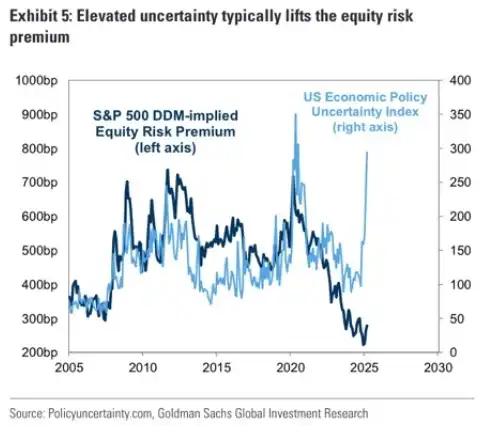
Goldman's report further reveals potential economic risks. The report points out that if the tariff policy is too aggressive, it could lead to rising U.S. inflation, slowing economic growth, and even increase the risk of recession from the current 25% to 35%. Earnings expectations for the S&P 500 index have been lowered, with earnings per share (EPS) dropping from $250 to $245 and the growth rate from 15% to 13%. Meanwhile, safe-haven sentiment has driven the price of gold to break through to new highs, showing that the market's concern about uncertainty has reached its peak.
The "Cascade Effect" in the Crypto Market: The High Correlation Between Bitcoin and the US Stock Market
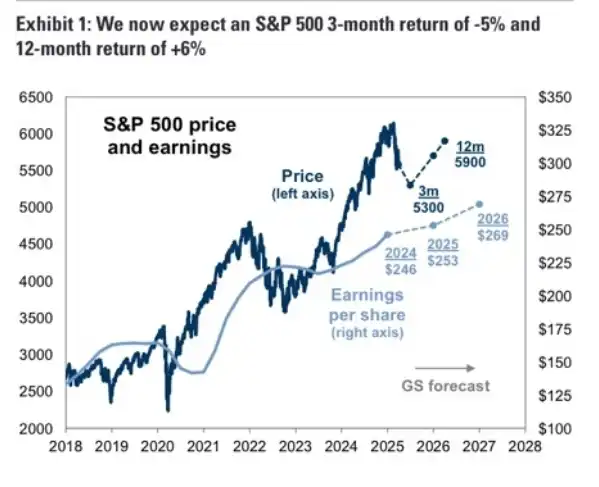
For the crypto market, Trump's tariff policy is not a distant macro event but a potential trigger for a chain reaction known as the "butterfly effect." In recent years, the high correlation between Bitcoin and the US stock market, especially the S&P 500 Index, has become a market consensus. Data from 2024 shows that the 90-day correlation between Bitcoin and the S&P 500 is as high as 0.85, indicating that stock market movements often drive Bitcoin in the same direction. The potential downside risk for the S&P 500 mentioned in a Goldman Sachs report (if there is an economic recession, the index could fall to 4500 points, a drop of about 12%) has undoubtedly sounded the alarm for Bitcoin.
This correlation has its logic: Although Bitcoin is often seen as "digital gold," its price is more driven by risk asset sentiment rather than pure safe-haven demand. During an economic slowdown or market panic, investors tend to sell off high-risk assets (including Bitcoin) in exchange for cash or safer assets (such as US Treasury bonds). In early 2025, Bitcoin's price briefly exceeded $110,000, but as tariff uncertainty intensified, its price has fallen back to around $82,000, demonstrating the market's sensitivity to risk.
Morgan Stanley Analysis: From Mild to Aggressive, Three Possible Tariff Scenarios
To better understand the tariff policy that Trump may announce on Wednesday, we can refer to Morgan Stanley's analytical framework, which divides potential outcomes into three scenarios: high-clarity low-tariff, low-clarity high-commitment, and high-clarity high-tariff. Each scenario will have a vastly different impact on the economy and the market.
Scenario One: High Clarity, Low Tariff Expansion
If Trump provides highly clear policy details on April 2 and the tariff expansion is small, while clearly stating that there will be no further broadening of the tariff scope, the additional impact on the economy may be relatively limited. The "nation-based" tariffs mentioned by Levitt may imply that the US will set equivalent tax rates based on each trade partner's average tariff level, rather than making significant adjustments targeting specific products or industries. For example, if a country's average tariff on US exports is 5%, the US may impose a 5% tariff on imports from that country.
In this scenario, market uncertainty will significantly decrease, and investors may breathe a sigh of relief. The US stock market may experience a rebound, especially in tech stocks and cyclical industries that were previously dragged down by tariff concerns. However, a Goldman Sachs report reminds us that even without new substantial tariffs, existing tariffs (such as the 25% tariffs on Canada and Mexico in early February and the additional 10% tariff on Chinese goods) will continue to pressure the economy. The US GDP growth rate in 2025 may be only 1.5%, far below the long-term average.
Scenario Two: Low Clarity but Significant Tariff Increase Promise
The second scenario is more uncertain. If Trump's statement lacks specific details but promises a significant future tariff increase, the market may fall into a deeper fog. Levitt mentioned that Trump plans to implement industry tariffs at some point in the future, which may include key sectors such as automobiles, pharmaceuticals, and semiconductors. This "pie in the sky" strategy may aim to force concessions from trading partners through negotiation, but it could also lead to heightened market panic.
In this case, investors may choose to wait and see rather than immediately adjust their portfolios. The S&P 500 Index may continue to fluctuate around its current level, finding it challenging to break through the resistance level (mentioned as 5300 points in a Goldman Sachs report). Meanwhile, the U.S. dollar may strengthen due to safe-haven demand, but rising inflation expectations may prompt the Federal Reserve to cut interest rates earlier. Goldman Sachs predicts that the Federal Reserve may cut interest rates three times in July, September, and November 2025, bringing the federal funds rate down from the current 4.25%-4.5% to 3.5%-3.75%.
Scenario Three: High Clarity, Significant Tariff Increase
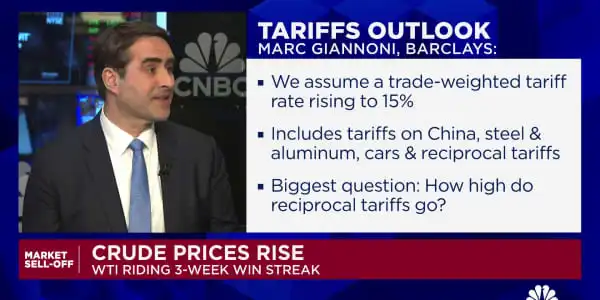
The most extreme scenario is that Trump announces a clear and aggressive tariff policy, with tariff rate increases exceeding expectations, even incorporating foreign consumption taxes and non-tariff barriers into the calculation. For example, if a country imposes a 20% tariff on U.S. cars and adds value-added tax, the U.S. may impose equivalent or even higher tariffs on goods from that country to "punish" non-tariff barriers. This aggressive policy could lead to a 15-percentage-point increase in the average tariff rate (Goldman Sachs' March 30 forecast), with an immediate impact on the economy.
In this scenario, the U.S. economic outlook would significantly deteriorate. Consumer prices may rise, real income may decrease, and business investment willingness could further decline. Morgan Stanley points out that in such a situation, fixed-income assets (such as bonds) would relatively benefit, while the stock market may experience a sharp decline, especially in technology and cyclical stocks. Scenario analysis in the Goldman Sachs report also indicates that if the economy enters a recession, the S&P 500 Index could drop to 4500 points, about 12% below the current level.
Hedging Logic in the Crypto Market: Gold Rises, Bitcoin Falls?
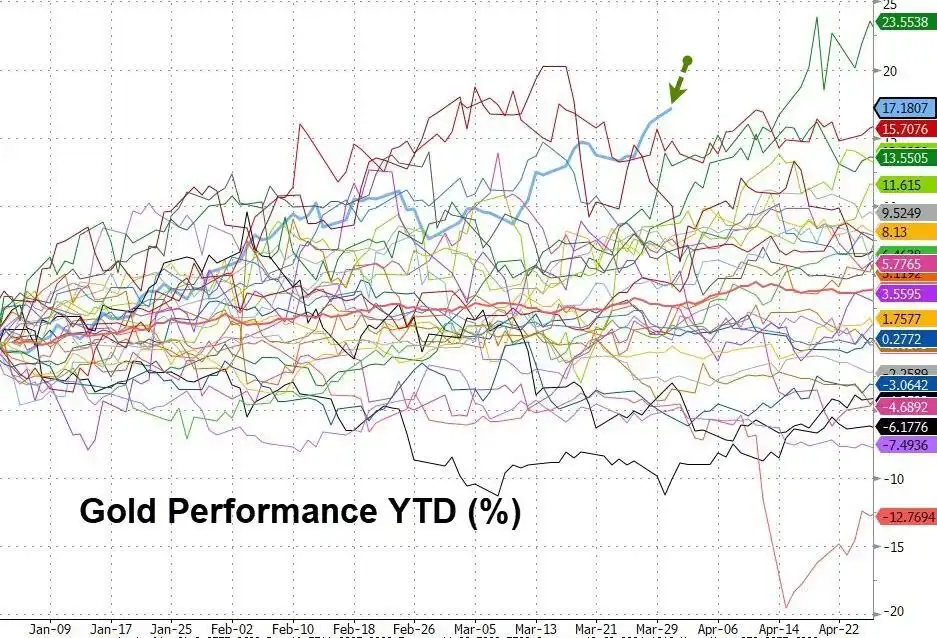
The heightened risk aversion mentioned in the Goldman Sachs report (gold hitting a new high) also provides an interesting contrast for the cryptocurrency market. Traditionally, gold has been seen as the ultimate safe-haven asset, while Bitcoin is often touted as "digital gold." However, reality is not so simple. In the first quarter of 2025, the price of gold rose by 19%, while Bitcoin fell by 15% during the same period, indicating that in the face of real macro risks, Bitcoin's hedging properties have not yet been fully recognized by the market.
For blockchain investors, this is a phenomenon worth pondering. Bitcoin's long-term value proposition (decentralization, anti-inflation) may be validated in the future, but in the short term, its price is more driven by macroeconomics and market sentiment. Inflationary pressure due to tariff policies may raise the expectation of Fed rate cuts, and a low-interest-rate environment typically benefits assets like Bitcoin. Therefore, if Trump's tariff policy ultimately leads to an economic hard landing, Bitcoin may experience a long-term rebound after a short-term decline.
Market and Investor Response
Faced with such uncertainty, how should investors respond? High-net-worth individuals recommend overallocating to high-quality stocks and defensive industries (such as healthcare and consumer essentials). For crypto investors, flexibility and risk management are equally important. Here are a few suggestions:
· Monitor the correlation between Bitcoin and the US stock market: If the S&P 500 falls, Bitcoin may follow suit with an adjustment. In the short term, risk exposure can be reduced, awaiting clearer policy signals.
· Diversify investments: In addition to Bitcoin, consider stablecoin or DeFi project's stable returns to hedge market volatility.
· Long-term perspective: If the tariff policy leads to a Fed accelerated rate cut, the low-interest-rate environment may provide long-term support for Bitcoin, making it suitable for buying on dips.
Global Perspective: Trade Partners' Reactions and the Ripple Effect on the Blockchain Industry
Trump's tit-for-tat tariff policy not only affects the US economy but may also trigger a significant adjustment in the global trade landscape. Major trade partners such as Canada, Mexico, and the EU have indicated they will impose retaliatory tariffs, while China may counter with restrictions on rare earth exports. This will have a profound impact on the global tech supply chain, especially the semiconductor industry. The blockchain industry heavily relies on chips (used for mining equipment and data centers). If the supply chain tightens, mining costs may rise, affecting Bitcoin network's hash rate and price.
Trump's tit-for-tat tariff policy is undoubtedly a bombshell for the global economy and crypto market in 2025. Whether it's a mild adjustment or an aggressive move, Wednesday's statement will provide some clues to the market, and investors need to quickly interpret and adjust their strategies. Based on Goldman Sachs and Morgan Stanley's analysis, slowing economic growth and rising inflation are almost certain trends, and Bitcoin may follow stock market volatility in the short term but still has rebound potential in the long run. On April 2nd, will the rose in the rose garden wither due to the chilling wind of tariffs? For crypto investors, this may be a moment that is both perilous and full of opportunity.
You may also like

Japan’s Three Megabanks Plan Joint Stablecoin Issuance in Fiscal 2026
MUFG, SMBC, and Mizuho reportedly plan to jointly issue fiat-pegged stablecoins in fiscal 2026, signaling Japan’s growing push into bank-led digital payment infrastructure.

Humanity Discloses H Token Dual-Chain Attack Details, With Losses on Ethereum and BSC Exceeding $36 Million
Humanity said the H token attack across Ethereum and BSC caused more than $36 million in losses after leaked ProxyAdmin keys enabled malicious contract upgrades and token minting.

White House Discusses CLARITY Act With Law Enforcement Ahead of Senate Vote
The White House discussed the CLARITY Act with law enforcement ahead of a Senate vote, focusing on illicit finance risks and developer protections.

$75 billion in foreign capital has fled, and South Korean retail investors have absorbed it all using leverage

Bitcoin Trading Guide 2026: Strategies for Experienced Traders

What Is XAUT and PAXG? Why Tokenized Gold Is Booming in 2026

Cryptocurrency CEXs are flocking to sell US stocks, and traditional brokerages are facing an "uninvited guest."

Will the SpaceX IPO Hurt Bitcoin? Here's What Traders Are Watching
Foreign selling in the South Korean stock market accelerates, with cumulative net sales reportedly reaching $75 billion this year
On June 9, The Kobeissi Letter, citing Goldman Sachs data, reported that global investors are selling South Korean stocks at an unusually rapid pace. In the latest trading session, foreign investors sold about $801 million worth of Kospi constituent stocks again; total foreign outflows last week reached about $10 billion, and the market has been in net foreign selling on nearly every trading day over the past month. According to the data cited in the report, foreign investors have sold about $75 billion worth of South Korean stocks so far this year. Meanwhile, South Korean retail and institutional investors together recorded roughly $69 billion in net buying over the same period, suggesting that the market’s main buying support has come from domestic capital rather than returning overseas funds. The information currently disclosed still mainly comes from The Kobeissi Letter’s retelling and Goldman Sachs data summaries, while public details on the statistical period and the specific definition of “selling” remain relatively limited.

Fortune Warns of Strategy’s Financing Structure Risks as Bitcoin Premium Narrows
Fortune warned that Strategy’s Bitcoin treasury model faces growing financing risks as MSTR’s net asset premium narrows and preferred stock dividend pressure increases.

Ferrari Challenge Le Mans: Carl Moon to Dominate in WEEX Livery

Sahara AI Responds to SAHARA’s Sharp Drop: No Contract or Product Security Issues Found, Internal Investigation Underway
Sahara AI responded to SAHARA’s 60% price drop, saying no token contract or product security issues have been found and an internal investigation is underway.

WEEX Deposit/Withdrawal Dynamic Island: Your Asset Status, Always in Sight
Scaling Crypto Derivatives: The Digital Asset Infrastructure Behind High-Volume Trading
In the fast-moving digital asset ecosystem, derivatives platforms face an extreme architectural test. High-leverage futures markets demand more than just standard security—they require absolute operational precision, zero-latency matching engines, and ironclad structural scalability, all while navigating intense market volatility.
As global platforms scale to meet these demands, the industry is shifting away from rigid, monolithic setups toward a more agile, "decoupled" infrastructure philosophy.
The Blueprint for High-Volume Copy TradingFor elite global exchanges like WEEX (founded in 2018), this architectural choice becomes critical when scaling high-volume retail features like social copy trading. When thousands of users automatically mirror the real-time strategies of elite traders simultaneously, it triggers sudden, monumental spikes in concurrent transactional volume.
To prevent execution latency or settlement bottlenecks during these peak volatility events, a platform's primary engine must remain entirely dedicated to risk management, copy-trade synchronization, and order matching.
The Architectural Rule: New-generation platforms must separate front-end user execution engines from heavy backend infrastructural overhead to eliminate operational friction.
By separating these layers, platforms can maintain complete sovereignty over their trading environments and user experiences while strategically aligning with institutional-grade infrastructure ecosystems. This strategic framework allows modern exchanges to leverage advanced Digital Asset Custody infrastructure such as Cobo’s behind the scenes, ensuring that backend wallet management scales elastically alongside trading spikes.
Capitalizing on Market Momentum and 400× LeverageIn a derivatives arena where platforms offer up to 400× leverage on perpetual contracts, capital efficiency and market agility are core business metrics. To capture market momentum, an exchange needs the ability to rapidly expand its asset offerings, supporting everything from legacy crypto assets to sudden, trending altcoins across a massive library of trading pairs.
Adopting a flexible, scalable Wallet-as-a-Service (WaaS) solution such as Cobo’s could completely rewrite the development timeline for high-growth exchanges. Instead of spending months of engineering capital building out custom backend wallet architectures for every new blockchain network, platforms can deploy localized infrastructure in days.
This agility allows platforms to instantly scale their listings to over a thousand trading pairs without compromising security or delaying time-to-market. It mirrors the exact operational advantages seen during high-velocity market events, similar to how advanced wallet infrastructure empowers platforms during sudden asset surges; allowing exchanges to pass that speed and liquidity directly to their global user base.
A Mature Foundation for GrowthThe synergy between trusted infrastructure ecosystems and global trading platforms represents the natural evolution of a maturing crypto market. As WEEX continues to scale its global spot and derivatives offerings for over 6 million users, adopting robust backend paradigms proves that platforms no longer have to compromise between cutting-edge trading velocity and uncompromised structural security.

Morning Report | BitMine increased its holdings by 126,971 ETH last week; trader Eugene announced his exit from the crypto market

Wang Chuan: How can one not feel anxious after the neighbor Old Wang made thirty times profit by investing in storage stocks? (Seven) - A quarter-century cycle

Get Paid to Onboard? Try WEEX’s New Homepage with Rewards for Registration, Deposit & Trade
WEEX Custom Layout: Build Your Perfect Trading Workspace in Seconds
Japan’s Three Megabanks Plan Joint Stablecoin Issuance in Fiscal 2026
MUFG, SMBC, and Mizuho reportedly plan to jointly issue fiat-pegged stablecoins in fiscal 2026, signaling Japan’s growing push into bank-led digital payment infrastructure.
Humanity Discloses H Token Dual-Chain Attack Details, With Losses on Ethereum and BSC Exceeding $36 Million
Humanity said the H token attack across Ethereum and BSC caused more than $36 million in losses after leaked ProxyAdmin keys enabled malicious contract upgrades and token minting.
White House Discusses CLARITY Act With Law Enforcement Ahead of Senate Vote
The White House discussed the CLARITY Act with law enforcement ahead of a Senate vote, focusing on illicit finance risks and developer protections.
$75 billion in foreign capital has fled, and South Korean retail investors have absorbed it all using leverage
Bitcoin Trading Guide 2026: Strategies for Experienced Traders
What Is XAUT and PAXG? Why Tokenized Gold Is Booming in 2026


